
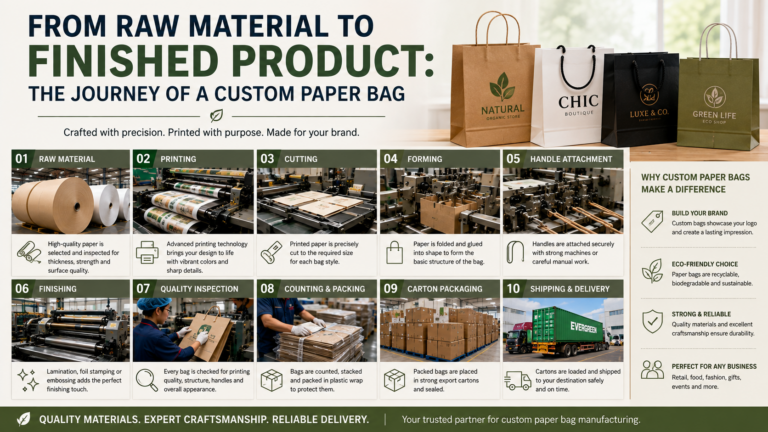

A custom paper bag may look simple when it reaches a retail store, restaurant, fashion brand, or promotional event. But behind that finished bag is a carefully controlled manufacturing process involving material selection, printing, cutting, forming, handle attachment, quality inspection, packing, and shipping.
For businesses ordering custom packaging, understanding how a paper bag is manufactured can make it much easier to choose the right material, structure, printing method, and supplier.
From the first roll of paper entering a factory to cartons being prepared for international delivery, every stage can affect the final appearance, strength, cost, and consistency of a custom paper bag.
Here is a closer look at the journey of a custom paper bag from raw material to finished product.
1. It Starts With the Right Paper
The manufacturing process begins with one of the most important decisions: selecting the right paper.
Different businesses have different packaging requirements. A fashion retailer may want a premium paper bag with a smooth surface and elegant finishing, while a restaurant may prioritize strength and grease resistance. A promotional campaign may focus more heavily on cost, printing quality, and delivery time.
Common paper materials used for custom paper bags include:
- Kraft paper
- White kraft paper
- White card paper
- Coated paper
- Recycled paper
- Specialty papers
Paper weight, texture, color, and surface finish all influence the final product.
For example, kraft paper can create a natural and eco-conscious appearance, while white card paper provides a clean background for colorful logos and detailed graphics.
The correct material should therefore be selected according to the bag’s application rather than simply choosing the cheapest option.
2. Paper Thickness Determines More Than Appearance
Paper thickness is another important factor in custom paper bag manufacturing.
A lightweight paper may be suitable for lightweight products and promotional applications, while thicker paper can provide additional structure and durability for retail packaging.
When selecting paper thickness, buyers should consider:
- Product weight
- Bag size
- Handle type
- Bottom construction
- Intended usage
- Desired appearance
- Shipping requirements
- Target price
A larger bag carrying heavier products generally requires a stronger overall structure.
However, simply increasing paper thickness is not always the best solution. The bag’s dimensions, bottom construction, handle reinforcement, and manufacturing process also contribute significantly to its carrying capacity.
3. Artwork Is Prepared Before Printing
Once the material has been selected, the next stage is preparing the artwork.
The logo, brand colors, product information, graphics, and other design elements need to be converted into production-ready artwork.
A professional packaging manufacturer will normally review the artwork before production to check important details such as:
- Logo positioning
- Dimensions
- Bleed areas
- Color requirements
- Printing areas
- Text readability
- Folding positions
- Handle placement
This stage is particularly important because a small mistake in artwork positioning can become a much larger problem once the paper has been printed and formed into bags.
For B2B buyers, confirming the artwork carefully before mass production can help reduce unnecessary production delays and avoid costly corrections.
4. Printing Brings the Brand to Life
After artwork approval, the paper moves into the printing process.
Printing is one of the most visible stages of paper bag manufacturing because it determines how the brand appears on the finished packaging.
Depending on the project, manufacturers may use different printing technologies and processes.
The printing process needs to maintain consistency across large production quantities. Logo colors should remain as close as possible to the approved artwork, while text and graphics need to remain sharp and properly positioned.
For brands ordering thousands of bags, consistency is especially important.
Imagine a retailer receiving 50,000 bags where the logo appears slightly different from one batch to another. Even though each individual bag may look acceptable, the inconsistency can weaken the overall brand presentation.
That is why printing quality control is an essential part of professional paper bag production.
5. Surface Finishing Can Change the Look and Feel
Some custom paper bags require additional surface finishing after printing.
Depending on the desired appearance and application, options may include:
- Matte lamination
- Gloss lamination
- Varnishing
- Foil stamping
- Embossing
- Debossing
- Special textures
Finishing can change both the visual appearance and tactile experience of the bag.
For premium retail packaging, for example, a combination of a carefully selected paper, minimalist artwork, and subtle finishing can create a much more sophisticated result than a standard printed bag.
However, finishing should be selected based on the brand’s positioning and budget rather than added simply because more finishing sounds more premium.
6. The Printed Paper Is Cut to Size
Once printing and finishing are completed, the large sheets or rolls of paper need to be converted into the appropriate dimensions for bag production.
Precision cutting is essential.
The paper must be cut according to the approved bag specifications so that the subsequent folding and forming stages can be completed accurately.
At this point, manufacturing tolerances become important.
If the paper is not cut correctly, problems can appear later during folding, bottom forming, handle attachment, or final assembly.
This is why a well-organized custom paper bag factory uses production equipment and inspection procedures designed to maintain dimensional consistency.
7. Folding Creates the Basic Bag Structure
The next stage is where a flat piece of printed paper begins to become an actual bag.
The paper is folded according to the required bag design.
Depending on the construction, this can include forming:
- Front and back panels
- Side gussets
- Bottom panels
- Folding lines
- Reinforced areas
- Handle attachment areas
The structure of the bag needs to match the original specifications.
For example, a wide-bottom bag designed for food packaging may require a different construction from a narrow luxury shopping bag.
The bag’s dimensions and structure are therefore not independent decisions. They work together to determine how the finished packaging performs.
8. Bottom Construction Provides Stability
The bottom of a paper bag plays a major role in its strength.
A well-constructed bottom allows the bag to stand properly and distribute the weight of the contents.
Different bag designs may use different bottom structures depending on the application.
For B2B buyers, bottom construction is particularly important when the bag will be used for:
- Clothing
- Shoes
- Food
- Gift products
- Cosmetics
- Bottles
- Retail purchases
- Promotional products
A bag that looks attractive but cannot maintain its structure under normal use will ultimately create a poor customer experience.
9. Handles Are Attached
Handles may seem like a small detail, but they have a major impact on both usability and appearance.
Common handle options include:
- Twisted paper handles
- Flat paper handles
- Cotton rope handles
- Ribbon handles
- Die-cut handles
The appropriate handle depends on the bag’s design, expected load, brand positioning, and budget.
Handle attachment also requires attention to reinforcement and positioning.
For heavier retail packaging, the connection between the handle and bag needs to be strong enough to withstand repeated carrying.
For premium packaging, the handle can also become part of the visual identity.
A carefully selected rope or ribbon handle can make a basic paper bag feel substantially more refined.
10. Quality Inspection Takes Place Throughout Production
Quality control should not happen only after the bags are finished.
Professional paper bag manufacturing involves inspection throughout different stages of production.
Quality teams may check:
- Paper quality
- Paper thickness
- Printing accuracy
- Color consistency
- Bag dimensions
- Folding accuracy
- Bottom construction
- Handle attachment
- Surface finishing
- Overall appearance
Early inspection is valuable because it allows potential problems to be identified before they affect a large quantity of products.
For large B2B orders, this can significantly reduce the risk of receiving a shipment that does not meet the approved specifications.
11. Load Testing Helps Verify Bag Strength
For applications where carrying strength matters, load testing can provide another level of quality assurance.
A sample bag can be loaded with a specified weight to evaluate its performance.
Testing can help identify potential weaknesses in:
- Handles
- Handle attachment points
- Bag walls
- Bottom construction
- Paper strength
- Glue points
The exact testing requirements depend on the bag design and intended application.
A restaurant takeaway bag, for example, may have very different performance requirements from a luxury fashion shopping bag.
The important principle is simple: the finished bag should be evaluated according to how customers are actually expected to use it.
12. Sampling Comes Before Large-Scale Production
For many custom packaging projects, sampling is an important step before mass production.
A sample allows the buyer to physically evaluate the proposed packaging rather than relying entirely on digital artwork.
During sample evaluation, buyers can check:
- Actual paper appearance
- Color
- Logo size
- Logo position
- Bag dimensions
- Handle feel
- Bottom structure
- Overall appearance
- Carrying performance
A sample can also reveal details that are difficult to judge from a computer screen.
For this reason, businesses placing large custom packaging orders should consider sampling an important part of the purchasing process.
13. Mass Production Begins After Approval
Once the specifications and sample have been confirmed, the factory can move into mass production.
For a large order, production may involve automated machinery, multiple production stages, and coordinated quality inspections.
The goal is not simply to produce a large number of bags quickly.
The real objective is to produce a large quantity of bags that remain consistent with the approved specifications.
This is where factory production capability becomes particularly important for B2B buyers.
14. Automation Improves Production Efficiency
Modern paper bag factories can use automated equipment for many stages of production.
Automation can improve:
- Production speed
- Dimensional consistency
- Printing consistency
- Cutting accuracy
- Forming efficiency
- Labor efficiency
- Large-volume production capacity
However, automation does not eliminate the need for skilled workers.
Experienced operators and quality-control teams remain important for monitoring machinery, identifying abnormalities, handling special production requirements, and maintaining quality standards.
The strongest manufacturing process combines machinery with human quality control.
15. Handmade Processes Still Have Their Place
Not every custom paper bag is produced entirely by automated equipment.
Certain designs, structures, finishing processes, or premium packaging projects may require manual assembly or handmade processes.
Handmade work can be useful when a project requires:
- Special handle attachment
- Complex construction
- Small or medium production runs
- Premium finishing
- Unusual structures
- Detailed assembly
For buyers, it is useful to work with a manufacturer that can provide both automated production and flexible manual processing when necessary.
16. Finished Bags Are Counted and Packed
After production and final inspection, the finished bags are counted and prepared for shipment.
Packaging methods depend on the bag type and shipping requirements.
The bags may be:
- Bundled
- Packed into protective packaging
- Placed into cartons
- Counted by quantity
- Labeled according to the order
- Prepared for palletization
Proper packing protects the finished products during handling and international transportation.
For export orders, packaging also needs to consider carton dimensions, container utilization, and shipping efficiency.
17. Carton Loading and Warehouse Management
Before shipment, finished cartons are organized and prepared for logistics.
A professional factory should maintain clear production and warehouse procedures so that different customer orders can be correctly identified and separated.
This becomes particularly important when a manufacturer is handling multiple:
- Bag sizes
- Colors
- Designs
- SKUs
- Customer orders
- Production batches
Good warehouse management helps prevent quantity mistakes and order mix-ups.
18. The Journey Ends With Global Delivery
Once the order is ready, the cartons are handed over to the appropriate logistics channel.
Depending on the customer’s requirements, custom paper bags can be shipped internationally by sea, air, express, or other transportation methods.
For B2B buyers, production time is only one part of the overall lead time.
The complete timeline may include:
Artwork confirmation → Sampling → Production → Quality inspection → Packing → Export preparation → Shipping → Delivery
Understanding the entire timeline allows procurement teams to plan their packaging inventory more effectively.
19. What Determines the Cost of a Custom Paper Bag?
The price of a custom paper bag is influenced by multiple factors rather than one single number.
Important cost factors include:
Material
Different paper types and thicknesses have different costs.
Bag Size
Larger bags generally require more raw material.
Printing
Printing requirements, colors, artwork complexity, and printing area can influence the final cost.
Finishing
Lamination, foil stamping, embossing, and other finishing options can increase production costs.
Handle
Different handle materials and attachment methods have different costs.
Quantity
Larger production quantities can often provide better unit economics because setup and production costs are distributed across more bags.
Packaging and Shipping
Carton size, total volume, destination, and shipping method also affect the final delivered cost.
For this reason, requesting a quote based only on the phrase “custom paper bag” usually does not provide enough information for an accurate comparison.
20. How Should Businesses Choose a Custom Paper Bag Factory?
When evaluating a supplier, price should not be the only consideration.
B2B buyers should also evaluate:
- Manufacturing experience
- Product range
- Material options
- Printing capabilities
- Quality-control procedures
- Sampling process
- Production capacity
- Communication
- MOQ flexibility
- Packaging methods
- Export experience
- Delivery reliability
A supplier that offers a slightly lower unit price may not necessarily provide the lowest total cost if poor quality results in rejected goods, delays, or additional production.
The better approach is to evaluate the entire supply chain.
21. Why Factory-Direct Communication Matters
Working directly with a custom paper bag manufacturer can simplify the communication process.
Instead of communicating through multiple intermediaries, buyers can discuss specifications directly with the production team or supplier.
This can make it easier to confirm:
- Material requirements
- Artwork
- Dimensions
- Handle options
- Sampling
- Production schedules
- Quality requirements
- Packing instructions
- Shipping arrangements
For custom packaging, where small details can have a major impact on the final product, direct communication can be particularly valuable.
22. From a Roll of Paper to a Brand Experience
The journey of a custom paper bag begins with raw materials, but it ends with something much more valuable than a piece of folded paper.
It becomes part of the customer’s interaction with a brand.
A fashion customer carries the bag through a shopping district. A restaurant customer takes it home. A gift recipient sees the logo before opening the package. A promotional campaign turns the bag into a mobile branding tool.
That is why the manufacturing process matters.
Every stage, from paper selection and printing to handle attachment and final inspection, contributes to the finished customer experience.
The Complete Journey at a Glance
The manufacturing journey of a custom paper bag can be summarized as:
1. Material Selection
Choose the appropriate paper type, thickness, and texture.
2. Artwork Preparation
Confirm dimensions, logo placement, colors, and production specifications.
3. Printing
Apply the brand artwork with consistent color and detail.
4. Finishing
Add lamination, foil stamping, embossing, or other surface treatments when required.
5. Cutting
Cut the printed material accurately according to the bag specifications.
6. Forming
Fold and shape the paper into the required bag structure.
7. Bottom Construction
Create a stable and durable bottom structure.
8. Handle Attachment
Attach the selected handle securely and accurately.
9. Quality Inspection
Check appearance, dimensions, printing, structure, and carrying performance.
10. Packing & Shipping
Count, pack, carton, inspect, and prepare the finished bags for delivery.
Final Thoughts
A custom paper bag may only take a few seconds to pick up and carry, but producing a consistent, attractive, and durable bag requires a much longer journey.
For businesses, understanding this process makes it easier to communicate with suppliers, evaluate quotations, select materials, plan production schedules, and make better packaging decisions.
The best custom paper bag is not simply a bag with a logo printed on it. It is the result of thoughtful material selection, accurate production, quality control, and careful attention to the details that customers eventually see and feel.
From the first sheet of paper to the finished branded packaging, every stage has a role to play in turning a basic material into a useful packaging and branding tool.