
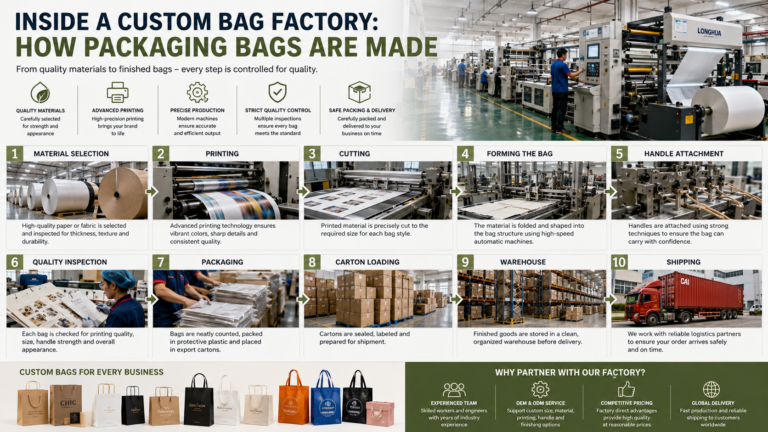

When customers see a finished custom packaging bag, they usually notice the logo, colors, shape, and overall appearance.
What they don’t see is everything that happens before the bag reaches the store.
Behind a professionally manufactured packaging bag is a production process involving material selection, printing, cutting, forming, handle attachment, quality control, packing, and shipping.
For B2B buyers, understanding how packaging bags are made can make it easier to evaluate suppliers, compare quotations, identify quality risks, and choose the right specifications for a project.
Whether you are ordering custom paper bags, non-woven bags, canvas bags, or other promotional packaging, the basic principle is the same:
Good packaging starts with good specifications and ends with consistent manufacturing.
So, what actually happens inside a custom bag factory?
Let’s walk through the process.
1. It Starts With the Packaging Specification
Before production begins, the factory needs a clear product specification.
A typical custom bag specification may include:
- Bag type
- Material
- Paper or fabric thickness
- Bag dimensions
- Handle type
- Handle length
- Printing method
- Printing colors
- Logo position
- Surface finishing
- Expected load capacity
- Quantity
- Packing requirements
For example, a custom paper shopping bag specification might look like:
Material: White card paper
Size: Custom
Printing: Full-color or spot-color printing
Handle: Cotton rope
Finishing: Matte lamination + foil stamping
Quantity: Bulk B2B order
The actual specification depends on the application.
A jewelry bag, fashion shopping bag, takeaway bag, and promotional tote may require completely different materials and structures.
2. Material Selection Comes Before Production
One of the most important decisions is selecting the right material.
Different materials create different combinations of:
- Appearance
- Strength
- Cost
- Texture
- Printing performance
- Reusability
- Sustainability characteristics
Common packaging bag materials include:
Kraft Paper
Kraft paper provides a natural appearance and is often associated with sustainability and simplicity.
It is commonly used for:
- Retail bags
- Gift bags
- Food packaging
- Takeaway packaging
- Boutique packaging
White Card Paper
White card paper provides a clean printing surface and is widely used for retail and premium packaging.
Coated Paper
Coated paper offers a smooth surface and can be suitable for detailed graphics and vibrant printing.
PP Non-Woven
PP non-woven material is lightweight, durable, and reusable.
It is commonly used for:
- Promotional bags
- Grocery bags
- Trade shows
- Retail shopping bags
- Event giveaways
Cotton and Canvas
Cotton and canvas provide a more textile-oriented appearance and are frequently used for reusable tote bags and promotional products.
The correct material depends on what the bag needs to accomplish.
3. Paper or Fabric Rolls Are Prepared for Production
For many large-scale manufacturing processes, materials arrive at the factory in rolls or sheets.
Before production, operators check the incoming material.
Depending on the product, they may inspect:
- Material thickness
- Surface quality
- Color
- Width
- Moisture
- Consistency
- Visible defects
For printed packaging, material consistency is particularly important.
If the substrate varies significantly between batches, printing and final appearance can also vary.
This is why material inspection is an important part of the production process.
4. Printing Creates the Brand Identity
Once the material is ready, the next major step is printing.
This is where a plain substrate becomes a branded packaging product.
Depending on the material and design, factories may use different printing technologies.
For paper bags, common approaches include:
- Flexographic printing
- Offset printing
- Gravure printing
- Digital printing
The appropriate method depends on factors such as:
- Order quantity
- Artwork complexity
- Number of colors
- Material
- Required image quality
- Cost target
For B2B projects, the factory should confirm the artwork and printing specifications before mass production begins.
5. Artwork Preparation Is Critical
Before printing thousands of bags, the artwork needs to be checked.
Typical artwork considerations include:
- Logo size
- Logo position
- Bleed
- Color values
- Fonts
- Images
- Barcode or QR code
- Printing area
- Finishing areas
For example, a logo may look perfectly centered in a digital file but appear slightly different once the bag is folded into its final three-dimensional shape.
This is why experienced manufacturers consider the final bag structure during artwork preparation.
6. Printing Quality Is Checked During Production
Printing is not simply a matter of pressing a button and walking away.
During production, operators may monitor:
- Color consistency
- Registration accuracy
- Printing position
- Ink coverage
- Smudging
- Scratches
- Surface defects
For large B2B orders, maintaining consistent color across thousands of bags is particularly important.
A brand that has carefully defined its corporate colors expects its packaging to reproduce those colors consistently.
7. Lamination and Surface Finishing
Some packaging bags require additional surface treatment.
For paper bags, options can include:
Matte Lamination
Creates a softer, more understated appearance.
Gloss Lamination
Provides a brighter and more reflective surface.
Foil Stamping
Adds metallic details, often used for premium or luxury packaging.
Embossing
Raises selected elements from the surface.
Debossing
Creates recessed details.
These finishing processes can add visual and tactile effects.
However, finishing should be selected according to the design and budget.
Not every packaging project needs multiple finishing techniques.
8. Paper Is Cut Into the Correct Size
After printing and finishing, the material needs to be converted into the actual bag structure.
Depending on the production system, machines can perform processes such as:
- Cutting
- Folding
- Creasing
- Gluing
- Forming
Precision is important here.
If dimensions are inconsistent, the final bags may have:
- Uneven sides
- Misaligned logos
- Poor folding
- Weak structures
- Inconsistent sizes
For this reason, production accuracy is an important part of manufacturing quality.
9. Bag Forming Creates the Final Structure
This is the stage where flat material becomes a three-dimensional packaging bag.
For paper bags, production may involve:
- Feeding printed paper
- Folding the paper
- Applying adhesive
- Forming the side panels
- Creating the bottom
- Reinforcing stress areas
- Preparing handle attachment points
Modern automated equipment can complete many of these steps at high speed.
However, the exact process depends on the bag style.
10. The Bottom Structure Determines Carrying Performance
The bottom of a shopping bag is one of the most important structural areas.
A bag needs to support the weight of its contents without deforming or opening.
Manufacturers may use different bottom structures depending on:
- Bag size
- Paper thickness
- Product weight
- Bag style
- Expected usage
For heavier products, additional reinforcement may be required.
This is why B2B buyers should not evaluate a bag only by its appearance.
A beautiful bag still needs to perform when it is filled.
11. Handles Are Added Separately or During Forming
Handles are another important part of packaging bag manufacturing.
Common paper bag handles include:
- Twisted paper handles
- Flat paper handles
- Cotton rope
- Polyester rope
- Ribbon handles
Non-woven and fabric bags may use:
- Same-material handles
- Webbing
- Reinforced fabric handles
Handle attachment methods vary by bag design.
The attachment point must be strong enough to handle the expected load.
This is particularly important for retail brands where customers may carry several products at once.
12. Different Bag Types Use Different Production Processes
Not every packaging bag is manufactured in the same way.
Paper Bags
A typical process may involve:
Paper → Printing → Finishing → Cutting → Folding → Gluing → Handle Attachment → Inspection
PP Non-Woven Bags
A typical process may involve:
PP Material → Spunbond Production → Printing → Cutting → Welding/Stitching → Handle Formation → Inspection
Canvas Bags
The process may involve:
Fabric → Cutting → Printing → Sewing → Handle Attachment → Finishing → Inspection
This is why choosing a supplier with experience in the specific bag category is important.
13. Non-Woven Bag Production
PP non-woven bags are widely used for reusable retail and promotional applications.
The production process may begin with polypropylene resin being converted into non-woven material.
The material is then processed into rolls or sheets.
After printing, the factory can cut the material into bag components.
Depending on the construction, bags may be produced using:
- Heat sealing
- Ultrasonic welding
- Sewing
- Automated forming
The choice depends on the bag structure and required durability.
14. Canvas Bag Production
Canvas bags generally involve more textile-oriented production processes.
The workflow can include:
Fabric Inspection → Cutting → Printing → Sewing → Handle Attachment → Trimming → Quality Inspection
Because sewing is involved, workmanship can have a significant effect on the final product.
Factories may inspect:
- Stitching
- Seam strength
- Handle attachment
- Fabric quality
- Printing
- Dimensions
For reusable bags, durability is especially important because the customer may use the bag repeatedly.
15. Quality Control Happens Throughout the Process
Quality control should not happen only at the end.
A well-organized manufacturing process checks quality at multiple stages.
Incoming Material Inspection
Check:
- Material quality
- Thickness
- Color
- Surface condition
Printing Inspection
Check:
- Color
- Registration
- Logo position
- Printing defects
Production Inspection
Check:
- Dimensions
- Folding
- Gluing
- Handle attachment
- Structural quality
Final Inspection
Check:
- Appearance
- Quantity
- Strength
- Packing
- Carton condition
This multi-stage approach helps reduce the risk of discovering large quantities of defective products at the end of production.
16. Load Testing Helps Verify Bag Strength
For shopping bags, strength matters.
Factories may perform practical load tests based on the product’s intended application.
Testing can examine:
- Handle strength
- Bottom strength
- Side seams
- Material performance
- Carrying capacity
For example, a bag intended for clothing may have different load requirements from a bag designed for heavy packaged goods.
B2B buyers should communicate the expected product weight to the manufacturer.
This allows the supplier to recommend an appropriate material and construction.
17. Sampling Comes Before Mass Production
For customized projects, samples can be extremely valuable.
A physical sample allows buyers to evaluate:
- Actual size
- Material
- Color
- Logo placement
- Handle
- Structure
- Finishing
- Overall appearance
Digital mockups are useful for design approval.
But a physical sample reveals details that screens cannot fully communicate.
For larger B2B orders, sample approval can significantly reduce production risk.
18. Automated Production Improves Efficiency
Modern packaging factories increasingly use automated machinery.
Automation can help improve:
- Production speed
- Dimensional consistency
- Labor efficiency
- Output capacity
- Repeatability
For high-volume orders, automation can be particularly valuable.
However, automation does not eliminate the need for quality control.
Machines still need:
- Correct setup
- Material feeding
- Maintenance
- Parameter control
- Inspection
The best results typically come from combining automation with experienced production management.
19. Handmade Processes Still Have a Place
Not every packaging bag should be fully automated.
Some premium or complex designs require manual processes.
Handmade production may be useful for:
- Special gift bags
- Complex structures
- Small batches
- Premium finishing
- Customized details
Manual work can provide flexibility when automated machinery is not suitable.
For B2B buyers, the key is choosing the appropriate manufacturing method for the product and order volume.
20. Packaging Inspection Before Shipment
Once production is complete, finished bags are inspected before packing.
Inspectors may check samples from the production batch for:
- Dimensions
- Printing
- Color
- Handle quality
- Bottom construction
- Surface defects
- Quantity
For larger orders, buyers may also request specific quality standards or inspection procedures.
Clear quality expectations should ideally be established before production begins.
21. Counting and Packing the Finished Bags
After inspection, the bags are counted and packed.
Packaging methods depend on:
- Bag size
- Material
- Quantity
- Shipping method
- Customer requirements
Finished bags may be packed into cartons.
Carton packing should protect the products from:
- Moisture
- Dust
- Compression
- Transportation damage
The factory also needs to consider carton weight and dimensions.
Efficient packing can reduce shipping volume and improve logistics efficiency.
22. International Shipping Is Part of the Production Process
For international B2B orders, manufacturing doesn’t end when the cartons leave the factory.
The final stage is delivery.
Depending on the order, shipping may involve:
- Sea freight
- Air freight
- Express shipping
- Truck transportation
- Multi-modal logistics
Lead time should therefore include more than manufacturing.
A buyer planning a seasonal campaign should consider:
Production Time + Inspection Time + Packing Time + Shipping Time + Customs/Delivery Time
Planning only around the factory production schedule can create unnecessary pressure later.
23. Why Factory Direct Communication Matters
When ordering custom packaging, communication between the buyer and manufacturer can directly affect the final product.
Important information should include:
- Exact dimensions
- Material
- GSM
- Artwork
- Printing requirements
- Handle specifications
- Quantity
- Delivery location
- Required delivery date
The clearer the specifications, the lower the risk of misunderstanding.
For B2B buyers, a professional supplier should be able to answer technical questions rather than simply provide a unit price.
24. What Determines the Cost of a Custom Bag?
Many factors influence the final price.
These can include:
Material
Different papers, fabrics, and non-woven materials have different costs.
Size
Larger bags generally require more material.
Thickness
Higher GSM or heavier materials may increase cost.
Printing
More complex artwork and additional colors can affect pricing.
Finishing
Foil, embossing, lamination, and other processes add production steps.
Handles
Premium handles can increase material and assembly costs.
Quantity
Larger production volumes can improve manufacturing efficiency and reduce unit costs.
Packing and Shipping
International logistics can represent a significant portion of the total landed cost.
This is why comparing suppliers only by the quoted bag price can be misleading.
25. MOQ Is Connected to Production Efficiency
Factories usually establish a minimum order quantity, or MOQ, because production involves setup costs.
These can include:
- Printing setup
- Material preparation
- Machine setup
- Plate or tooling costs
- Labor
- Packaging
For larger quantities, these fixed costs can be distributed across more units.
For example:
1,000 bags
and
50,000 bags
may use similar setup processes, but the setup cost is spread across a much larger number of products in the second order.
B2B buyers should therefore evaluate MOQ alongside unit price and total project requirements.
26. Repeat Orders Require Production Consistency
For retail brands, the first order is only part of the relationship.
A brand may reorder the same packaging every few months.
The supplier therefore needs to maintain consistency in:
- Material
- Dimensions
- Printing
- Color
- Handles
- Finishing
- Packing
A bag that looks different every time it is reordered can weaken brand consistency.
This is why keeping production specifications and approved samples is important.
27. Custom Packaging Is a Combination of Design and Engineering
From the outside, a packaging bag may appear simple.
Inside the factory, however, it involves both creative and technical decisions.
Design
Controls:
- Appearance
- Branding
- Color
- Graphics
- Finishing
Engineering
Controls:
- Structure
- Material thickness
- Load capacity
- Handle strength
- Production method
A successful packaging project needs both.
A beautiful design that cannot be produced efficiently is not a practical solution.
Likewise, a highly durable bag with poor branding may not deliver the desired customer experience.
28. How B2B Buyers Can Evaluate a Custom Bag Factory
Before choosing a supplier, consider:
1. Manufacturing Capability
Can the factory produce the specific bag type you need?
2. Customization
Can it support your required materials, sizes, handles, printing, and finishing?
3. Quality Control
Does the supplier have a clear inspection process?
4. Sampling
Can you review a physical sample before mass production?
5. Production Capacity
Can the factory handle your order volume?
6. Lead Time
Can the supplier meet your campaign or inventory schedule?
7. Repeat Orders
Can the factory maintain consistent specifications?
8. Communication
Can the supplier clearly communicate technical details and production progress?
These factors can be more important than simply finding the lowest quotation.
29. A Complete Custom Bag Manufacturing Workflow
The entire process can be summarized as:
1. Product Requirement
↓
2. Material Selection
↓
3. Artwork Preparation
↓
4. Sample Development
↓
5. Sample Approval
↓
6. Material Preparation
↓
7. Printing
↓
8. Lamination / Finishing
↓
9. Cutting
↓
10. Folding / Sewing / Forming
↓
11. Handle Attachment
↓
12. Quality Inspection
↓
13. Load / Structural Testing
↓
14. Counting & Packing
↓
15. Final Inspection
↓
16. Shipping
Each stage contributes to the final product.
30. Questions B2B Buyers Should Ask Before Ordering
Before placing a large packaging order, ask your supplier:
- What material do you recommend for my product?
- What GSM should I use?
- What is the expected load capacity?
- What printing method will be used?
- Can you provide a physical sample?
- How do you control color consistency?
- How are handles attached?
- How is the bottom reinforced?
- What quality checks are performed?
- What is the production lead time?
- What is the MOQ?
- How are finished bags packed?
- Can you support repeat orders?
- What shipping options are available?
The answers can reveal a lot about the supplier’s manufacturing capability.
31. From Factory Floor to Your Brand
The finished packaging bag may only take a few seconds to notice.
But behind that bag may be dozens of manufacturing decisions.
From the first material inspection to the final carton, every stage influences the finished product.
For B2B brands, this means that choosing a packaging supplier is not simply about finding someone who can print a logo.
It is about finding a manufacturing partner capable of translating a design specification into a consistent, functional, and brand-ready product.
Conclusion
Custom packaging bags are the result of a carefully coordinated manufacturing process.
From material selection and artwork preparation to printing, cutting, forming, handle attachment, quality control, packing, and shipping, every stage plays a role in the final result.
For B2B buyers, understanding this process makes it easier to evaluate suppliers and make better purchasing decisions.
The right custom bag factory should be able to provide more than a low quotation.
It should offer:
- Reliable materials
- Consistent production
- Flexible customization
- Professional sampling
- Quality control
- Suitable production capacity
- Clear communication
- Reliable delivery
Whether you’re ordering custom paper bags for a retail chain, non-woven bags for a promotional campaign, canvas totes for a fashion brand, or premium gift bags for a seasonal collection, the manufacturing process behind the product matters.
A finished bag may look simple. A well-made bag is anything but simple.