
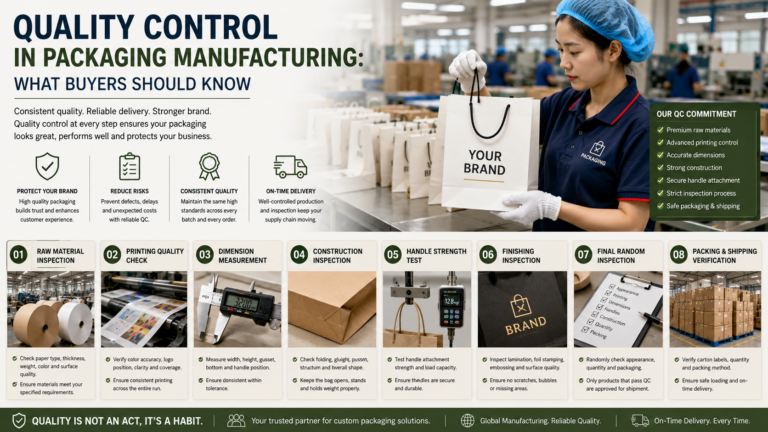

When ordering custom packaging in large quantities, product quality is just as important as price.
A custom paper bag may look perfect in a sample, but producing 10,000, 50,000, or even 100,000 bags consistently is a completely different challenge. Small variations in printing, dimensions, handles, materials, or construction can become significant problems when they are repeated across an entire production batch.
For B2B buyers, quality control is therefore not simply a factory responsibility. It is an important part of supplier evaluation, order management, and risk control.
Understanding how quality control works in packaging manufacturing can help procurement teams choose reliable suppliers, establish clearer specifications, and reduce the possibility of receiving products that do not meet expectations.
What Is Quality Control in Packaging Manufacturing?
Quality control, often called QC, refers to the processes used to inspect packaging materials and finished products to ensure they meet predetermined specifications.
For custom packaging, QC can cover the entire manufacturing process, including:
- Raw material inspection
- Printing inspection
- Color consistency
- Dimension checks
- Structural inspection
- Handle attachment
- Surface finishing
- Load testing
- Appearance inspection
- Quantity verification
- Packing inspection
The goal is not simply to identify defective products at the end of production.
A strong quality-control system identifies potential problems as early as possible.
This is especially important for customized packaging because every order may have different materials, dimensions, artwork, handles, finishing options, and performance requirements.
Why Quality Control Matters to B2B Buyers
For consumers, one defective bag may be an inconvenience.
For a business purchasing tens of thousands of bags, the consequences can be much larger.
A quality problem can lead to:
- Rejected products
- Production delays
- Additional shipping costs
- Missed product launches
- Packaging shortages
- Customer complaints
- Brand image problems
- Expensive reorders
Imagine a retailer preparing for a major seasonal campaign. The bags arrive, but the logo color is noticeably different from the approved sample.
The factory may consider the bags usable, but the retailer may not.
This is why quality should be defined before production rather than discussed only after something goes wrong.
1. Raw Material Quality Should Be Checked First
Quality control starts before the bag itself is manufactured.
For paper bags, the raw material can have a significant impact on the final product.
Factories may inspect materials for:
- Paper type
- Paper thickness
- Weight
- Surface quality
- Color
- Texture
- Strength
- Moisture condition
- General consistency
Different applications require different materials.
A luxury retail bag may require a smooth premium paper, while a takeaway bag may prioritize durability and structural performance.
For B2B buyers, the important question is not simply:
“What paper do you use?”
A better question is:
“What exact paper specification will be used for my order?”
This creates a clearer reference for both the buyer and manufacturer.
2. Paper Thickness Needs to Match the Specification
Paper thickness can influence both appearance and performance.
If the paper is too thin for the intended application, the bag may feel weak or fail under heavier loads.
If the paper is unnecessarily thick, however, the buyer may end up paying more for material without receiving meaningful additional value.
Quality control should therefore verify that the material used in production matches the approved specification.
For buyers, it can be useful to confirm:
- Paper GSM
- Paper type
- Paper color
- Surface finish
- Recycled content, when applicable
- Material supplier or specification, when relevant
Material consistency becomes particularly important for repeat orders.
A brand that orders the same bag every six months should not receive a noticeably different material each time.
3. Printing Quality Is One of the Most Visible QC Factors
Printing problems are among the easiest quality issues for customers to notice.
A logo that is too dark, too light, blurry, misaligned, or printed in the wrong position can immediately affect the appearance of the packaging.
Printing inspection may include:
- Color accuracy
- Logo clarity
- Text sharpness
- Graphic details
- Printing position
- Ink coverage
- Smudging
- Scratches
- Missing areas
- Registration accuracy
For brands with strict visual identity guidelines, color consistency can be especially important.
The approved artwork and production sample should provide a clear reference for mass production.
4. Color Consistency Matters for Brand Packaging
Brand colors are often more important than buyers initially realize.
A packaging bag may contain the company’s primary brand color, product colors, or specific corporate identity elements.
If the color varies significantly between batches, the packaging can look inconsistent across stores, markets, or campaigns.
For this reason, buyers should establish a clear color reference before production.
Depending on the project, this may include:
- CMYK values
- Pantone references
- Digital artwork
- Approved physical samples
A good supplier should also understand that digital colors displayed on different screens are not necessarily an exact representation of the final printed result.
For high-volume projects, approving a physical production sample can provide a much stronger reference.
5. Dimensions Should Be Measured
A custom bag is manufactured according to specific dimensions.
Typical specifications may include:
- Width
- Height
- Gusset
- Bottom dimensions
- Handle length
- Handle spacing
- Fold position
Even small dimensional variations can affect how a bag looks and performs.
For example, if the gusset is different from the approved specification, the bag may have a noticeably different shape.
For packaging used with a specific product, dimensional accuracy becomes even more important.
If the bag is designed around a particular box, bottle, clothing item, or gift package, the finished bag needs to accommodate that product properly.
6. Bag Structure Affects Performance
Two bags can have the same dimensions and paper thickness but perform differently because their construction is different.
Structural QC may examine:
- Folding
- Side gussets
- Bottom construction
- Glue points
- Reinforcement areas
- Handle positioning
- Overall symmetry
A bag should not only look correct when it is empty.
It should also perform properly when used as intended.
This is why structural inspection is an important part of professional packaging manufacturing.
7. Handle Quality Should Never Be Overlooked
Handles are one of the most important functional components of a shopping bag.
Depending on the product, a custom paper bag may use:
- Twisted paper handles
- Flat paper handles
- Cotton rope handles
- Ribbon handles
- Other customized handle options
QC can check:
- Handle material
- Handle length
- Handle position
- Attachment strength
- Knot or connection quality
- Reinforcement
- Visual consistency
For heavier products, handle attachment is particularly important.
A beautiful printed bag is not a successful packaging solution if the handle fails during normal use.
8. Load Testing Helps Verify Carrying Strength
When carrying performance matters, load testing can provide useful information about how the bag behaves under weight.
A sample bag can be filled with a specified load and evaluated for:
- Handle strength
- Bottom strength
- Glue strength
- Paper performance
- Structural stability
The appropriate testing method depends on the bag’s design and application.
A lightweight promotional bag does not necessarily require the same performance level as a retail bag designed to carry shoes, bottles, or heavier products.
The test should therefore reflect the real-world use of the packaging.
9. Surface Finishing Needs Inspection
Premium packaging often includes additional finishing processes.
These may include:
- Matte lamination
- Gloss lamination
- Foil stamping
- Embossing
- Debossing
- Varnishing
- Special textures
Quality control should verify that the finishing is properly applied.
Potential problems can include:
- Uneven lamination
- Scratches
- Air bubbles
- Peeling
- Incorrect foil position
- Incomplete embossing
- Surface damage
For premium brands, these small details can make a noticeable difference in the final customer experience.
10. Glue and Assembly Quality Matter
Adhesive points may not be highly visible, but they are critical to the structure of many packaging products.
QC teams may inspect whether:
- Glue is evenly applied
- Seams are properly bonded
- Edges are secure
- There is excessive adhesive
- The bag opens and folds correctly
- The structure remains stable during use
Excessive glue can create an unattractive appearance, while insufficient adhesive can weaken the bag.
Good manufacturing requires a balance between appearance and structural reliability.
11. Quality Inspection Should Happen During Production
One common misunderstanding is that QC only happens when production is finished.
In reality, quality control is more effective when it is performed at multiple stages.
A typical process may look like:
Raw Material → Printing → Cutting → Forming → Handle Attachment → Final Inspection → Packing
Inspection at different stages allows problems to be discovered earlier.
For example, if printing is found to be incorrect after only a small quantity has been produced, the issue can potentially be corrected before the entire order is completed.
This can significantly reduce waste and production risk.
12. Pre-Production Samples Reduce Risk
Before mass production, a sample can help buyers confirm the actual product.
A production sample allows the buyer to evaluate:
- Material
- Color
- Logo
- Dimensions
- Handles
- Construction
- Finishing
- Overall appearance
This is especially valuable for large or complex orders.
A digital rendering may look perfect on a screen, but the physical sample reveals details that cannot always be judged digitally.
For high-volume B2B orders, sample approval should ideally be documented before mass production begins.
13. First-Article Inspection Can Be Valuable
For customized packaging, buyers can request an initial production sample or first article before the full production run continues.
The purpose is simple:
Confirm that the factory is producing the actual product according to the approved specifications.
This can include checking:
- Material
- Size
- Printing
- Color
- Handle
- Construction
- Finishing
If something is wrong, it can be corrected before the issue spreads across the entire production batch.
14. Final Inspection Checks the Finished Goods
After production, finished bags should be inspected before packing and shipment.
A final inspection may include:
Appearance
Check for:
- Scratches
- Stains
- Printing defects
- Wrinkles
- Surface damage
- Uneven finishing
Dimensions
Confirm that the finished bag remains within the agreed specifications.
Construction
Check:
- Bottom
- Side seams
- Folding
- Glue points
- Handles
Printing
Verify:
- Logo
- Color
- Position
- Text
- Graphics
Quantity
Confirm that the correct quantity has been produced and packed.
15. Packaging Inspection Is Also Important
Even high-quality bags can be damaged if they are packed incorrectly.
Before shipment, buyers and manufacturers should consider:
- Inner protection
- Carton strength
- Carton dimensions
- Bag stacking
- Moisture protection
- Labeling
- Palletization
- Shipping environment
For international B2B orders, packaging for transportation deserves special attention.
The goal is not simply to protect the bags inside the factory.
The packaging should help protect them throughout handling, loading, transportation, unloading, and final delivery.
16. Quantity Verification Prevents Order Problems
Quantity errors can be surprisingly disruptive.
Imagine ordering 30,000 bags for a retail campaign and receiving fewer than expected.
Even if the difference seems small, the missing quantity may create packaging shortages at stores or distribution centers.
Factories should therefore have processes for:
- Counting finished products
- Verifying carton quantities
- Recording production quantities
- Checking carton labels
- Confirming shipment quantities
Clear packing lists and carton markings can also make receiving goods easier for buyers.
17. Repeat-Order Consistency Is a Major B2B Concern
For many businesses, the first order is only the beginning.
A brand may reorder the same packaging several times over several years.
This creates another important quality requirement:
Consistency between production batches.
The second order should not look dramatically different from the first without an agreed change.
Important repeat-order references may include:
- Material specification
- Paper thickness
- Dimensions
- Artwork
- Color reference
- Handle type
- Construction
- Finishing
Maintaining clear production records can make repeat orders much more consistent.
18. What Should Buyers Include in Their QC Requirements?
When requesting a quotation, buyers should provide as much relevant information as possible.
A useful packaging specification can include:
Product: Custom Paper Bag
Material: Kraft Paper / White Card Paper / Coated Paper
Size: Width × Height × Gusset
Paper GSM: Required specification
Printing: Number of colors / printing method
Handle: Type, material, length
Finishing: Matte / Gloss / Foil / Embossing
Quantity: Required order quantity
Application: Retail / Food / Gift / Fashion / Promotional
Quality requirements: Appearance, strength, dimensional tolerance
Packaging: Carton requirements
Delivery: Destination and required timeline
The clearer the specification, the easier it becomes for different suppliers to provide comparable quotations.
19. Questions Buyers Should Ask a Packaging Manufacturer
Before placing a large order, buyers can ask:
1. What quality-control procedures do you use?
This helps determine whether the supplier has a structured QC system.
2. Do you provide pre-production samples?
Samples help confirm specifications before mass production.
3. How do you control printing consistency?
This is especially important for branded packaging.
4. How do you verify bag strength?
Ask whether load testing or other performance checks are available.
5. How do you handle defective products?
A professional supplier should have a clear process for identifying and managing non-conforming products.
6. Can you maintain consistency for repeat orders?
This is critical for long-term B2B relationships.
7. Can you provide production photos or inspection information?
Factory documentation can provide additional visibility during production.
20. Quality vs. Price: What Should Buyers Really Compare?
Price is an important part of any B2B purchasing decision.
But comparing suppliers only by unit price can be misleading.
Consider two suppliers:
Supplier A: Lower unit price, but inconsistent printing and weak handles.
Supplier B: Slightly higher unit price, but stronger quality control and more consistent production.
If Supplier A produces defective bags that need to be replaced, the apparent price advantage may disappear.
The real cost of packaging can include:
Product Price + Shipping + Inspection + Defects + Delays + Rework + Replacement Costs
This is why procurement teams should evaluate the total cost and supply-chain risk rather than focusing exclusively on the cheapest quotation.
21. Quality Control Supports Brand Protection
Packaging is part of the customer-facing brand experience.
A poorly printed logo, weak handle, damaged surface, or inconsistent color can make a business appear less professional.
For brands operating across multiple stores or countries, consistent packaging can also strengthen visual identity.
A reliable quality-control system helps businesses protect that consistency.
In this sense, QC is not simply a manufacturing expense.
It is part of brand protection.
22. What Makes a Reliable Packaging Manufacturer?
A reliable packaging manufacturer should be able to demonstrate more than attractive product photos.
B2B buyers should look for evidence of:
- Stable production capabilities
- Clear material specifications
- Professional printing processes
- Multiple inspection points
- Sample approval procedures
- Production records
- Experienced quality-control personnel
- Consistent packing procedures
- Export experience
- Clear communication
A manufacturer that can clearly explain its QC process is generally easier to work with than a supplier that only promises “good quality.”
Specific processes are more useful than vague promises.
23. A Practical QC Checklist for Packaging Buyers
Before approving a custom packaging order, buyers can use this checklist:
Material
- Correct material
- Correct paper GSM
- Correct surface
- Material quality approved
Printing
- Logo correct
- Colors approved
- Printing position correct
- No obvious printing defects
Dimensions
- Width correct
- Height correct
- Gusset correct
- Handle length correct
Construction
- Bottom structure correct
- Side seams secure
- Glue points secure
- Bag opens and stands correctly
Handles
- Correct material
- Correct position
- Strong attachment
- Suitable for intended load
Finishing
- Lamination correct
- Foil stamping correct
- Embossing correct
- Surface free of major defects
Packing
- Correct quantity
- Cartons properly sealed
- Labels correct
- Products protected during transportation
24. Build QC Into the Purchasing Process
The most effective approach is to treat quality control as part of the purchasing process from the beginning.
Instead of:
Order → Production → Hope Everything Is Correct
A stronger process is:
Specification → Quotation → Sample → Approval → Production → In-Process QC → Final QC → Packing → Shipment
This approach gives both the buyer and manufacturer clearer expectations.
It also creates more opportunities to identify problems before they become expensive.
Final Thoughts
Quality control in packaging manufacturing is about much more than checking whether a finished bag looks good.
It begins with raw material selection and continues through printing, cutting, forming, handle attachment, finishing, testing, inspection, packing, and shipping.
For B2B buyers, understanding these processes makes it easier to evaluate suppliers and reduce purchasing risk.
When comparing custom packaging manufacturers, look beyond the quotation.
Ask how materials are controlled. Ask how printing is inspected. Ask how dimensions and handles are checked. Ask how samples are approved. Ask how defects are handled. Most importantly, ask how the supplier maintains consistency when producing thousands of pieces.
A reliable packaging partner should not simply deliver a large quantity of bags.
They should deliver the right product, at the required quality, in the required quantity, and according to the approved specifications.
That is what professional quality control is ultimately designed to achieve.