
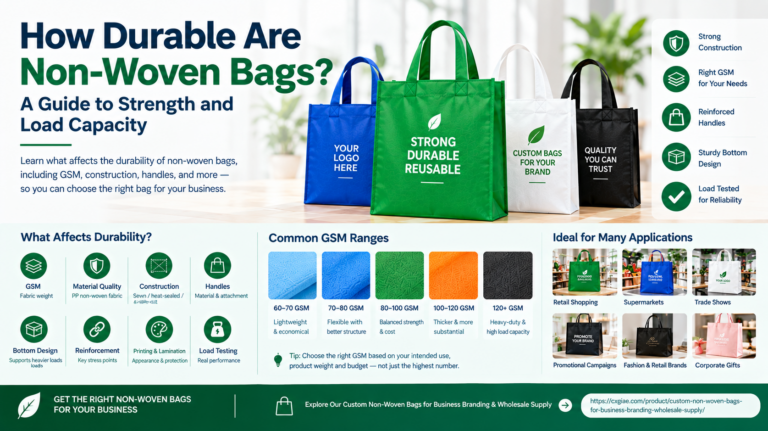

When businesses consider reusable packaging, one of the first questions is often: How durable are non-woven bags?
For retailers, supermarkets, promotional companies, fashion brands, and other businesses purchasing bags in bulk, durability is more than a product feature. It directly affects customer experience, packaging performance, brand reputation, and the overall value of the purchase.
A non-woven bag that looks attractive but cannot handle the intended load can quickly become a packaging problem. On the other hand, choosing a bag that is significantly stronger than necessary may increase material and transportation costs without providing meaningful additional value.
So how strong are non-woven bags, and what determines their load capacity?
The answer depends on much more than the fabric itself.
In this guide, we will examine the key factors that determine non-woven bag durability, strength, and load capacity, helping B2B buyers make better purchasing decisions.
What Makes Non-Woven Bags Durable?
Most commercial non-woven shopping bags are made from polypropylene (PP) non-woven fabric.
PP non-woven fabric is lightweight, flexible, printable, and suitable for producing reusable bags in a wide range of sizes and designs.
However, the durability of a finished bag depends on several factors working together:
- Fabric GSM
- Material quality
- Bag dimensions
- Bag construction
- Handle design
- Handle attachment
- Bottom construction
- Sewing or heat-sealing quality
- Reinforcement
- Printing and lamination
- Intended load
- Manufacturing quality control
This means two bags made from the same type of PP non-woven fabric can have noticeably different performance.
For B2B buyers, the right question is therefore not simply:
“What GSM is the bag?”
A better question is:
“Can the complete bag structure safely carry the products it is designed for?”
How Does GSM Affect Non-Woven Bag Strength?
GSM means grams per square meter and describes the weight of the non-woven fabric.
In general, higher GSM means a heavier and more substantial fabric.
Commercial non-woven bags are often produced using different fabric weights depending on the application. A range around 70–120 GSM is commonly used for many business and promotional applications.
As a general guide:
| GSM | General Characteristics | Typical Applications |
|---|---|---|
| 60–70 GSM | Lightweight and economical | Events, giveaways, promotional campaigns |
| 70–80 GSM | Lightweight with improved structure | Trade shows, promotional packaging |
| 80–100 GSM | Balanced strength and cost | Retail, supermarkets, general shopping |
| 100–120 GSM | Thicker and more substantial | Reusable shopping, premium packaging |
| 120+ GSM | Heavy-duty material | Specialized high-strength applications |
However, higher GSM does not automatically guarantee higher load capacity.
A bag’s dimensions, handle construction, seams, bottom structure, and material quality can all affect how much weight it can safely carry.
This is why GSM should be treated as one specification within a complete bag design.
Why Bag Size Affects Load Capacity
Bag dimensions can have a significant impact on durability.
A small bag and a large bag made from the same GSM fabric do not necessarily have the same performance characteristics.
A larger bag uses more material and may hold more products, which can increase the total load placed on the handles and bottom.
For example, a large shopping bag designed to hold several boxed products may require stronger construction than a small promotional bag designed for brochures.
When designing a custom non-woven bag, manufacturers should consider:
- Width
- Height
- Gusset depth
- Handle length
- Handle width
- Bottom structure
- Intended load
The larger the bag and the heavier the contents, the more important the overall structural design becomes.
The Handles Are a Critical Strength Point
When customers carry a shopping bag, much of the load is transferred through the handles.
This makes handle construction one of the most important factors in determining practical load capacity.
Buyers should consider:
- Handle material
- Handle width
- Handle length
- Handle attachment
- Stitching
- Sealing
- Reinforcement
- Distance between handle attachment points
A bag can have relatively thick fabric but still perform poorly if the handles are not properly attached.
For bags intended to carry heavier products, reinforced handle attachment can help distribute stress and improve reliability.
This is particularly important for retail and supermarket applications where customers may fill the bag close to its intended capacity.
Sewn Non-Woven Bags and Durability
Sewn non-woven bags are constructed using stitching to join fabric sections and attach handles.
Sewing can provide a durable connection and is often suitable for reusable bags that need to withstand repeated handling.
For a sewn bag, buyers should evaluate:
- Stitch density
- Stitch consistency
- Seam position
- Handle stitching
- Reinforcement
- Fabric GSM
- Overall bag structure
The quality of the sewing process matters just as much as the choice of fabric.
A well-designed sewn bag can provide reliable performance for retail, promotional, event, and reusable shopping applications.
Heat-Sealed Non-Woven Bags
Heat-sealed non-woven bags use controlled heat to bond PP non-woven material.
This construction method is commonly used for certain high-volume bag designs and can support efficient automated production.
Heat-sealed bags can be durable when the material, temperature, pressure, sealing area, and production parameters are properly controlled.
For B2B buyers, it is useful to ask the manufacturer which construction method is recommended for the intended load and application.
The cheapest production method is not necessarily the most appropriate one for every bag design.
How the Bottom Construction Affects Strength
The bottom of a shopping bag carries a significant portion of the product weight.
A bag with a flat or gusseted bottom may behave differently depending on its dimensions and construction.
When the bag is filled, the bottom needs to support the weight while maintaining the overall structure.
For heavier applications, buyers should consider:
- Bottom design
- Gusset construction
- Seam strength
- Reinforcement
- Fabric GSM
- Bag dimensions
If the bag is intended to carry bottles, boxed products, cosmetics, food containers, or other relatively heavy items, bottom construction deserves particular attention.
Does Lamination Make a Non-Woven Bag Stronger?
Laminated non-woven bags have an additional surface layer applied to the fabric.
Lamination can provide benefits such as:
- Smoother surface
- Different visual appearance
- Improved print presentation
- Additional surface protection
- More structured feel
- Increased resistance to certain surface conditions
However, lamination should not automatically be interpreted as a guarantee of significantly higher load capacity.
The bag’s structural strength still depends on its base fabric, construction, handles, seams, bottom, and manufacturing quality.
Lamination is often selected for a combination of appearance and functional requirements, rather than simply for maximum load capacity.
How Much Weight Can a Non-Woven Bag Carry?
There is no single load-capacity number that applies to all non-woven bags.
The safe or recommended load depends on the complete specification.
Important variables include:
- GSM
- Bag size
- Bag shape
- Fabric quality
- Handle design
- Handle attachment
- Construction method
- Bottom structure
- Reinforcement
- Expected frequency of use
A small promotional bag may be designed for lightweight materials, while a larger reusable shopping bag may be engineered for a significantly higher load.
For this reason, B2B buyers should avoid choosing a bag based on a generic statement such as “strong non-woven bag.”
Instead, communicate the actual expected load to the manufacturer.
For example:
“The bag needs to carry approximately 5 kg of retail products.”
This gives the manufacturer a practical performance requirement to work with.
Load Capacity vs. Reusability
Durability is not only about the maximum weight a bag can carry once.
For reusable packaging, buyers should also consider how the bag performs after repeated use.
A reusable shopping bag may experience:
- Repeated loading and unloading
- Folding and unfolding
- Handle stress
- Contact with different products
- Transportation
- Storage
- Frequent customer handling
Therefore, a bag designed for repeated use may require a different material and construction specification from a disposable promotional giveaway.
When durability matters, buyers should discuss the expected usage frequency, not only the maximum load.
How Different Applications Affect Durability Requirements
Different business applications require different levels of bag strength.
Retail Shopping Bags
Retail bags need to balance appearance, cost, carrying comfort, and durability.
They may carry:
- Clothing
- Shoes
- Accessories
- Gift items
- Cosmetics
- Packaged products
Medium or higher GSM can be considered depending on the products and desired customer experience.
Supermarket Shopping Bags
Supermarket applications can place greater demands on the bag because customers may carry multiple products at once.
Buyers should pay particular attention to:
- Handle strength
- Bottom construction
- Fabric GSM
- Reinforcement
- Bag dimensions
- Expected load
Load testing can be useful when the bags are intended for heavier shopping applications.
Trade Show Bags
Trade show bags generally carry:
- Brochures
- Catalogs
- Flyers
- Samples
- Promotional products
They may not require the same heavy-duty construction as supermarket bags.
In these situations, lightweight or medium-weight fabric can provide a better balance between durability and logistics cost.
Promotional Campaigns
Promotional bags are often produced in large quantities.
The main priorities may include:
- Low unit cost
- Lightweight transportation
- Attractive printing
- Sufficient strength for promotional materials
Using unnecessarily heavy fabric can increase the total project cost without providing additional value.
Fashion and Premium Retail
Fashion brands may prioritize both durability and presentation.
A higher-GSM or laminated non-woven bag with reinforced handles can provide a more substantial customer experience.
The bag should match the brand’s product positioning and expected usage.
How to Improve Non-Woven Bag Durability
If a business needs stronger bags, increasing GSM is only one possible solution.
Other options include:
Use Appropriate GSM
Choose a fabric weight that matches the intended load and frequency of use.
Strengthen the Handles
Handle reinforcement can improve performance at one of the bag’s most heavily stressed areas.
Optimize the Bottom
A suitable bottom structure can help distribute the weight of the contents.
Choose the Right Construction
Sewn, heat-sealed, and die-cut designs have different characteristics and applications.
Adjust the Bag Dimensions
An oversized bag may require additional structural considerations if it is expected to carry heavy products.
Add Reinforcement Where Needed
Specific stress points can be reinforced depending on the design and intended application.
Conduct Load Testing
Testing the finished product provides more meaningful information than relying on GSM alone.
Why Load Testing Matters for B2B Buyers
For large commercial orders, load testing can help reduce the risk of receiving a product that does not perform as expected.
A basic load test can evaluate whether the bag can carry a specified weight without:
- Handle failure
- Seam failure
- Excessive stretching
- Bottom damage
- Fabric tearing
- Structural deformation
Testing requirements should be agreed with the manufacturer before production when the application has specific performance expectations.
For example, if a retailer expects the bag to carry approximately 5 kg, this requirement should be communicated during the quotation and development stage.
That gives the manufacturer an opportunity to select the appropriate material and construction.
Durability and Manufacturing Quality
Material specifications alone cannot guarantee a durable finished bag.
Manufacturing consistency is equally important.
Quality control can include:
- Fabric GSM inspection
- Material appearance inspection
- Dimension checking
- Handle inspection
- Stitching inspection
- Heat-sealing inspection
- Bottom construction inspection
- Printing inspection
- Load testing
- Finished-product inspection
- Packing inspection
For large B2B orders, production consistency matters because thousands of bags need to meet the same approved specifications.
A supplier should be able to translate the approved sample into consistent mass production.
What Should Buyers Include in an RFQ?
When requesting a quotation for durable custom non-woven bags, provide as much information as possible.
A useful specification might include:
Material: PP non-woven
GSM: 80–120 GSM or supplier recommendation
Size: Custom width × height × gusset
Construction: Sewn / heat-sealed / die-cut
Handle: Custom length and width
Printing: Custom logo and brand colors
Expected Load: Approximately 5 kg
Usage: Reusable retail shopping
Quantity: 10,000 pcs
Destination: United States / Europe / other market
This allows the manufacturer to evaluate the entire product rather than quoting based on a generic bag style.
How to Choose a Durable Non-Woven Bag Supplier
When comparing manufacturers, B2B buyers should look beyond the lowest price.
Consider whether the supplier can provide:
- Clear material specifications
- Different GSM options
- Custom sizes
- Multiple construction methods
- Handle customization
- Reinforcement options
- Printing capabilities
- Physical samples
- Load testing
- Production quality control
- Consistent mass production
- Export and delivery support
A manufacturer that understands how material, structure, and application work together can often provide a better solution than a supplier that simply sells standard bags.
For businesses looking for a customized solution, you can learn more about custom non-woven bags for business branding and wholesale supply, including options for different business applications, sizes, materials, and branding requirements.
Durable Does Not Always Mean Heavy
One of the biggest misconceptions in packaging procurement is that durability requires using the heaviest possible material.
In reality, effective packaging design is about matching the construction to the application.
A lightweight promotional bag can be durable enough for brochures and flyers.
A medium-weight retail bag may provide the right balance for everyday shopping.
A heavier, reinforced bag may be more appropriate for products that place greater stress on the packaging.
The objective is not to maximize every specification.
The objective is to achieve the right combination of:
Material + GSM + Construction + Handles + Dimensions + Load Capacity
Non-Woven Bag Durability Buyer Checklist
Before approving a bulk order, buyers can use this checklist:
Material
- Is the bag made from PP non-woven fabric?
- What GSM is being used?
- Is the material laminated?
Structure
- What construction method is used?
- Is the bottom reinforced?
- Are the handles reinforced?
Performance
- What weight should the bag carry?
- Is it intended for single or repeated use?
- Has the finished bag been load tested?
Quality
- Has a physical sample been approved?
- Will the same material specification be used during mass production?
- What quality control procedures are used?
Commercial Requirements
- What is the MOQ?
- What is the production lead time?
- What are the packing requirements?
- What is the delivery destination?
Answering these questions before production can help reduce quality risks and improve procurement accuracy.
Final Thoughts
So, how durable are non-woven bags?
The answer depends on how the bag is designed and manufactured.
PP non-woven fabric can provide a practical combination of lightweight construction, flexibility, customization, and durability. But the final load capacity is determined by much more than GSM.
For B2B buyers, the most important factors include fabric weight, bag dimensions, handle construction, bottom design, sewing or heat-sealing quality, reinforcement, and intended load.
If a bag needs to carry heavier products or withstand repeated use, the manufacturer should evaluate the complete structure and, when appropriate, conduct load testing.
The best non-woven bag is not necessarily the thickest or most expensive one. It is the bag engineered for the job it needs to perform.
By defining the expected load, application, usage frequency, and desired appearance before production, businesses can select a more reliable packaging solution while maintaining control over cost.
For brands, retailers, supermarkets, promotional companies, and other organizations purchasing custom bags in bulk, the right combination of material, construction, and quality control can turn a simple non-woven bag into a dependable part of the packaging strategy.