
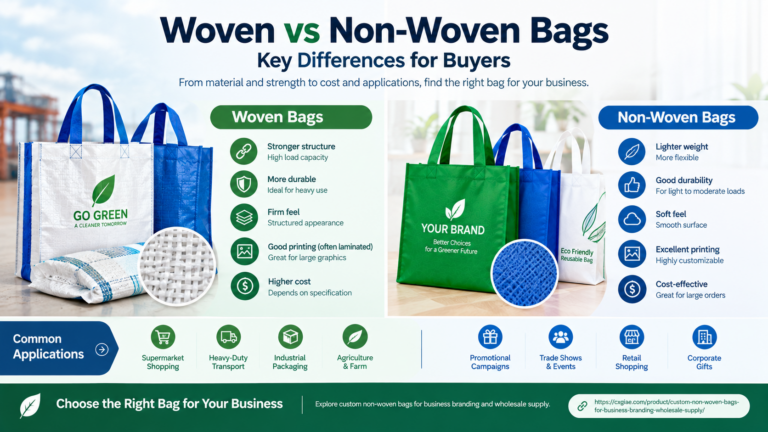

When businesses are sourcing reusable bags for retail, promotions, events, supermarkets, or branded packaging, they often come across two similar-sounding options: woven bags and non-woven bags.
At first glance, the difference may not seem obvious. Both can be made from polypropylene (PP), both can be customized with logos, and both can be used as reusable shopping or promotional bags.
However, the way the materials are manufactured creates significant differences in their structure, strength, appearance, flexibility, printing options, and ideal applications.
For B2B buyers, choosing between woven and non-woven bags should not simply come down to which one has the lower unit price. The better choice depends on what the bag needs to carry, how often it will be reused, how it should look, and how much branding is required.
This guide explains the key differences between woven vs non-woven bags and provides a practical framework for choosing the right option for your business.
What Is the Difference Between Woven and Non-Woven Bags?
The biggest difference is how the fabric itself is made.
Woven Bags
Woven bags are made by interlacing threads, tapes, or strips of material together.
For woven polypropylene bags, PP is typically processed into thin tapes that are then woven together to create a structured fabric.
The finished material has a recognizable cross-pattern or grid-like appearance.
This woven structure gives the material a firm and durable character, making woven bags particularly suitable for applications where carrying strength and repeated use are important.
Non-Woven Bags
Non-woven bags are made without weaving threads together.
For common PP non-woven bags, polypropylene fibers are bonded together to create a sheet-like fabric.
The result is generally softer, lighter, and more flexible than woven PP fabric.
Non-woven bags are widely used for:
- Promotional campaigns
- Trade shows
- Retail packaging
- Shopping bags
- Corporate events
- Product giveaways
- Branded packaging
The fundamental difference can therefore be summarized as:
Woven = interlaced material structure
Non-woven = bonded fiber structure
That manufacturing difference influences many of the characteristics buyers care about.
Woven vs Non-Woven Bags at a Glance
| Feature | Woven Bags | Non-Woven Bags |
|---|---|---|
| Material structure | Interlaced threads or PP tapes | Bonded fibers |
| Typical feel | Firm and structured | Soft and fabric-like |
| Flexibility | Lower | Higher |
| Strength | Generally higher for heavy-load applications | Suitable for light to moderate loads depending on design |
| Weight | Generally more substantial | Lightweight |
| Printing | Good, especially when laminated | Good and highly customizable |
| Appearance | Structured, technical, or retail-oriented | Soft, clean, promotional, or retail-oriented |
| Common use | Heavy-duty and reusable applications | Promotional, retail, event, and shopping bags |
| Cost efficiency | Depends on specification | Often attractive for high-volume projects |
| Construction | Often sewn and reinforced | Sewn, heat-sealed, or die-cut |
| Best for | Higher-load and repeated-use applications | Branding, promotions, retail, and general shopping |
The table provides a general comparison. The actual performance of a finished bag depends on its material specification, dimensions, construction, handles, reinforcement, and manufacturing quality.
How Are Woven Bags Made?
Woven PP bags begin with polypropylene, which is processed into narrow tapes.
These tapes are then woven together using a loom, creating a fabric with an interlocking structure.
The woven material can subsequently be:
- Cut
- Sewn
- Laminated
- Printed
- Reinforced
- Formed into different bag styles
The interlaced structure is one of the main reasons woven PP fabric is commonly selected for applications requiring greater structural strength.
Lamination can also be added to create a smoother surface for printing and provide additional surface protection.
How Are Non-Woven Bags Made?
PP non-woven fabric is produced without the traditional weaving process.
Polypropylene is processed into fibers or filaments, which are formed into a web and bonded together.
The resulting material can then be converted into different bag styles through processes such as:
- Sewing
- Heat sealing
- Die cutting
- Handle attachment
- Printing
- Lamination
Because the material is produced as a sheet-like fabric, it can be efficiently converted into many promotional and retail bag designs.
Woven vs Non-Woven: Which Is Stronger?
In general, woven PP bags are better suited to higher-load applications, because the interlaced structure provides strong tensile performance and a more structured material.
Non-woven bags can also be durable, particularly when the correct GSM, construction, handles, and reinforcement are selected.
However, they are generally more appropriate for lightweight to moderate carrying applications rather than demanding industrial loads.
This does not mean that every woven bag is stronger than every non-woven bag.
A finished bag’s performance depends on the entire design.
Important factors include:
- Fabric weight
- Material quality
- Bag dimensions
- Handle design
- Handle attachment
- Bottom construction
- Stitching
- Heat sealing
- Reinforcement
- Intended load
For B2B buyers, it is better to specify the required load rather than simply asking for the “strongest” material.
Woven vs Non-Woven: Which Is More Flexible?
Non-woven bags generally have a softer and more flexible feel.
This makes them convenient for:
- Folding
- Storage
- Promotional distribution
- Trade shows
- Event campaigns
- Lightweight retail packaging
Woven PP bags tend to feel more structured.
The material can hold its shape better, which may be desirable for reusable shopping bags and larger bags carrying heavier products.
If your project requires a bag that is easy to fold, distribute, and store in large quantities, non-woven can be a practical choice.
If the bag needs a more structured form and higher load capacity, woven PP may be worth considering.
Woven vs Non-Woven: Which Has Better Printing?
Both materials can be customized with branding, but the printing approach can differ.
Non-Woven Bags
Non-woven bags can be customized with:
- Company logos
- Brand colors
- Text
- Promotional graphics
- Event information
- Custom patterns
The relatively smooth fabric surface makes non-woven bags suitable for many branding applications.
For high-volume promotional campaigns, simple logo printing can be particularly cost-efficient.
Woven Bags
Woven PP has a more textured surface because of its interlaced construction.
For this reason, woven bags are often laminated when buyers require a smoother surface and more detailed or full-surface graphics.
Lamination can create a more uniform printing surface and also influence the appearance and structure of the finished bag.
For projects requiring large-area branding, detailed artwork, or a more retail-oriented finish, buyers should discuss the printing and lamination options with the manufacturer before selecting the material.
Woven vs Non-Woven: Which Looks More Premium?
“Premium” is not determined by material alone.
However, the two materials create noticeably different visual and tactile impressions.
Non-Woven
Non-woven bags generally have a softer, fabric-like appearance.
They can look clean and professional, especially when customized with:
- Strong brand colors
- Minimalist logos
- High-quality printing
- Custom handles
- Laminated surfaces
- Well-designed proportions
They are often used for promotional and retail packaging where brand visibility is important.
Woven
Woven bags tend to have a more structured and substantial appearance.
Laminated woven bags can support large printed graphics and a more rigid retail presentation.
They may be particularly suitable when the bag itself is intended to feel like a durable reusable product rather than a short-term promotional giveaway.
Ultimately, the right appearance depends on your brand positioning.
Woven vs Non-Woven: Which Is More Cost-Effective?
Cost depends on the complete specification rather than material type alone.
Factors include:
- Material weight
- Bag size
- Material consumption
- Printing
- Lamination
- Handle type
- Sewing
- Reinforcement
- Order quantity
- Packaging
- Shipping
Non-woven bags can be an attractive option for large promotional orders because lightweight material and efficient production can help control project costs.
Woven bags may require a more substantial material and construction, but the additional investment can make sense when the bag needs higher durability and repeated use.
The better question is therefore not:
“Which bag is cheaper?”
Instead:
“Which bag provides the best value for the intended use?”
A lower-cost bag that fails under the required load is not actually a cost-effective packaging solution.
Woven vs Non-Woven for Retail Stores
Retail businesses should consider the products that customers will carry.
Non-Woven Can Be Suitable For:
- Clothing
- Accessories
- Cosmetics
- Gifts
- Lightweight packaged goods
- Promotional products
The soft material, customization flexibility, and relatively lightweight construction make non-woven bags a practical option for many retail environments.
Woven Can Be Suitable For:
- Heavier merchandise
- Larger shopping loads
- Reusable shopping programs
- Supermarket applications
- Retail programs requiring a more structured bag
For a fashion brand selling lightweight products, non-woven may provide sufficient performance.
For a retailer expecting customers to reuse the bag for heavier shopping, woven PP may be a better fit.
Woven vs Non-Woven for Promotional Campaigns
Promotional campaigns often involve very large quantities.
This changes the procurement priorities.
Businesses may need:
- Competitive unit cost
- Fast production
- Efficient shipping
- Large printable areas
- Consistent logo quality
- Lightweight packaging
- Easy distribution
Non-woven bags are frequently suitable for this type of project.
For example, a company attending a trade show may need thousands of bags to distribute brochures, catalogs, samples, and promotional products.
There may be little benefit in using a heavy-duty woven bag for such an application.
Woven vs Non-Woven for Trade Shows
Trade show bags have a very specific job.
They need to carry marketing materials while providing a large area for brand visibility.
For many exhibitions, a non-woven bag can provide a good balance between:
- Weight
- Cost
- Printing
- Flexibility
- Carrying capacity
If the contents are particularly heavy or the company wants the bag to become a long-term reusable product, a woven option may also be considered.
The right choice depends on the event strategy and intended lifespan of the bag.
Woven vs Non-Woven for Supermarkets
Supermarket applications can place greater demands on packaging.
Customers may put multiple products into one bag, creating significant stress on the handles and bottom.
For higher-load reusable shopping applications, woven PP is often worth considering because of its stronger and more structured construction.
However, a properly designed non-woven bag can also work for many shopping applications when the fabric weight, handles, dimensions, and construction are selected appropriately.
Load testing is recommended when specific carrying requirements are involved.
Woven vs Non-Woven for Corporate Events
Corporate events often prioritize branding and large-volume distribution.
Non-woven bags can be a practical option when companies need thousands of branded bags for:
- Conferences
- Seminars
- Exhibitions
- Product launches
- Employee events
- Promotional campaigns
The material can provide sufficient durability for brochures, documents, promotional products, and lightweight merchandise.
If the bag is intended to become a premium corporate gift that recipients will reuse for a long time, a more structured woven design may be worth considering.
What About Laminated Woven and Laminated Non-Woven Bags?
Lamination can make the comparison more complicated because both materials can be laminated.
Laminated Non-Woven Bags
Laminated non-woven bags typically combine a non-woven base with a surface film.
They can offer:
- Smoother appearance
- Stronger visual presentation
- More detailed printing possibilities
- A more structured feel
- Additional surface protection
Laminated Woven Bags
Laminated woven bags combine the strength and structure of woven PP with a smooth laminated surface.
They are often selected for:
- Reusable shopping bags
- Supermarket programs
- Large retail bags
- Heavy-duty promotional packaging
- High-area branding
When comparing quotations, buyers should clarify exactly what material structure is included.
“PP bag” alone is not enough information for an accurate comparison.
Woven vs Non-Woven: What About GSM?
GSM is especially important when evaluating non-woven bags.
GSM means grams per square meter and indicates the weight of the non-woven fabric.
Common commercial non-woven bags may use different GSM specifications depending on their intended application.
For example:
- Lower GSM can support lightweight promotional applications
- Medium GSM can provide a balance between cost and durability
- Higher GSM can provide a more substantial feel and support certain reusable applications
However, GSM should not be used as the only indicator of bag strength.
Bag dimensions, handle construction, seams, bottom structure, and material quality all matter.
For woven bags, buyers may need to evaluate different material specifications rather than directly comparing GSM numbers between woven and non-woven fabrics.
The two materials have fundamentally different structures, so a simple GSM comparison does not necessarily provide a meaningful strength comparison.
Which One Is More Sustainable?
Sustainability is more complicated than simply choosing woven or non-woven.
Both woven and non-woven PP bags can be designed for repeated use, but their environmental impact depends on factors such as:
- Material composition
- Manufacturing
- Bag lifespan
- Number of reuse cycles
- Recycling infrastructure
- End-of-life treatment
- Transportation
- Overall material consumption
A durable bag that is repeatedly reused can provide more value than a bag that is used once and discarded.
For buyers with specific sustainability requirements, it is important to ask suppliers about the actual material composition and any relevant certifications or recycled-content specifications rather than relying only on general terms such as “eco-friendly.”
Woven vs Non-Woven: How Should B2B Buyers Decide?
A simple decision framework can make procurement easier.
Choose Non-Woven When You Prioritize:
- Lightweight construction
- High-volume promotional campaigns
- Competitive project cost
- Flexible bag designs
- Trade shows and events
- Retail packaging for light to moderate loads
- Easy customization
- Promotional branding
Consider Woven When You Prioritize:
- Higher load capacity
- Repeated heavy use
- More structured construction
- Larger reusable shopping bags
- Supermarket applications
- Long-term durability
- A more substantial bag feel
- Large-area laminated printing
Neither material is universally better.
The correct choice depends on the application.
8 Questions to Ask Before Ordering
Before requesting a quotation, B2B buyers should define:
- What products will the bag carry?
- What is the approximate maximum load?
- How frequently will the bag be reused?
- What bag dimensions are required?
- Does the project require lamination?
- What type of printing is required?
- What handle and reinforcement design is needed?
- What quantity and target cost are expected?
Providing these details allows a manufacturer to recommend a more appropriate material.
Sample Testing Is Better Than Guessing
When the material choice is unclear, requesting samples of both woven and non-woven versions can be extremely useful.
Compare the samples based on:
- Fabric feel
- Bag structure
- Weight
- Handle comfort
- Printing quality
- Load capacity
- Appearance
- Folding and storage
- Overall customer experience
For B2B procurement, testing the actual bag with the products it will carry is often more useful than comparing material names or catalog photos.
A bag that looks excellent on a specification sheet still needs to perform in the real world.
Custom Non-Woven Bags for Business Applications
If your project is better suited to non-woven material, the next step is to define the complete specification.
Depending on the application, buyers can consider:
- Custom bag size
- PP non-woven GSM
- Sewn or heat-sealed construction
- Handle style
- Laminated or non-laminated material
- Custom printing
- Reinforcement
- Packaging requirements
- Bulk production quantity
For businesses looking for customized non-woven bags, you can explore custom non-woven bags for business branding and wholesale supply and review the available options for different commercial applications.
Final Thoughts
The difference between woven and non-woven bags starts with how the fabric is manufactured.
Woven bags use an interlaced structure, which generally gives them a firmer feel and makes them well suited to higher-load and repeated-use applications.
Non-woven bags use bonded fibers, creating a lightweight, flexible material that is widely used for promotional campaigns, retail packaging, trade shows, events, and general shopping applications.
Neither option is automatically the best.
For B2B buyers, the right choice depends on:
Load + Usage + Branding + Construction + Budget + Expected Lifespan
If the primary goal is lightweight branded packaging at scale, non-woven can be an efficient solution.
If the project requires higher carrying capacity, stronger structure, and repeated heavy use, woven PP may be more appropriate.
The smartest procurement decision is therefore to start with the actual job the bag needs to perform, then select the material and construction that meet those requirements without adding unnecessary cost.
When the material, dimensions, handles, construction, printing, and load requirements are clearly defined, businesses can turn a simple bag purchase into a much more reliable packaging strategy.