

When businesses order custom non-woven bags, one specification often appears on the quotation or product sheet: GSM.
But what does GSM actually mean?
For B2B buyers, understanding GSM is important because fabric weight can influence the overall feel, durability, material consumption, cost, and suitability of a non-woven bag for different applications.
A promotional bag for a trade show may not need the same GSM as a reusable retail shopping bag. Similarly, a bag designed to carry lightweight clothing may require a different material specification from one intended for heavier products.
This guide explains what GSM means in non-woven bags, how it affects performance, and how buyers can choose the right GSM for their business needs.
What Does GSM Mean?
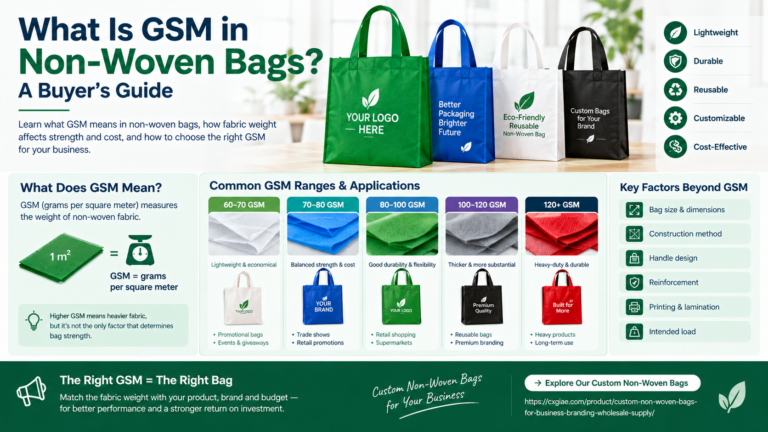
GSM stands for grams per square meter.
It measures how much one square meter of fabric weighs.
For example, if a non-woven fabric is specified as 80 GSM, one square meter of that material weighs approximately 80 grams.
In simple terms:
Higher GSM = heavier fabric per square meter
Lower GSM = lighter fabric per square meter
GSM is widely used in the textile and non-woven industry because it provides buyers and manufacturers with a standardized way to describe fabric weight.
However, GSM should not be treated as a direct measurement of finished bag strength.
A bag’s actual performance also depends on its dimensions, construction, handle design, seams, bottom structure, material quality, and manufacturing process.
Why Does GSM Matter for Non-Woven Bags?
GSM matters because the fabric is one of the main components of a non-woven bag.
Changing the GSM can affect several characteristics of the finished product.
1. Fabric Thickness and Feel
In general, higher-GSM non-woven fabric tends to feel thicker and more substantial.
This can create a more premium impression when customers handle the bag.
Lower-GSM fabric generally feels lighter and may be preferred when minimizing material consumption and transportation weight is important.
For brands, the physical feel of packaging can contribute to how customers perceive product quality.
2. Durability
Fabric weight can influence the durability of a non-woven bag.
A suitable higher-GSM material can provide a stronger and more substantial structure, especially when combined with appropriate construction and reinforcement.
However, GSM is only one part of the equation.
For example, a 120 GSM bag with poorly designed handles may not outperform a well-constructed 90 GSM bag in every carrying situation.
This is why professional manufacturers evaluate fabric, handles, seams, bottom construction, and intended load together.
3. Material Consumption
Higher GSM means more material weight per square meter.
If the bag dimensions remain the same, increasing the GSM generally increases the amount of material used in production.
This can affect the unit cost.
For large B2B orders involving thousands or tens of thousands of bags, even a relatively small change in material specification can influence the overall project cost.
4. Transportation Weight
GSM can also affect logistics.
A higher-GSM bag generally contains more material and may therefore contribute more weight to the shipment.
For international B2B buyers, transportation cost can be an important part of total packaging cost.
This means the ideal GSM is not necessarily the highest available. Instead, buyers should choose a specification that provides the required performance without unnecessary material consumption.
Common GSM Ranges for Non-Woven Bags
There is no universal GSM standard that applies to every non-woven shopping bag.
Different manufacturers and applications may use different specifications.
As a practical reference, commercial PP non-woven bags are often discussed in ranges such as:
| GSM Range | General Characteristics | Typical Applications |
|---|---|---|
| 60–70 GSM | Lightweight and economical | Promotional giveaways, events |
| 70–80 GSM | Lightweight with improved structure | Trade shows, campaigns, retail promotions |
| 80–100 GSM | Balanced performance and cost | Retail, supermarkets, promotional bags |
| 100–120 GSM | Thicker and more substantial | Reusable shopping bags, premium promotional packaging |
| 120+ GSM | Heavy-duty feel and higher material usage | Specialized or high-load applications |
These ranges are general guidelines rather than strict industry rules.
The correct specification should always be determined according to the actual bag design and intended use.
Is Higher GSM Always Better?
No.
This is one of the most important points for B2B buyers.
It is easy to assume that a 120 GSM bag must always be better than an 80 GSM bag.
But packaging procurement is not a competition to find the highest number.
The objective is to find the right material specification for the application.
Consider a company ordering 20,000 promotional bags for a trade show.
The bags may only need to carry:
- Brochures
- Flyers
- Catalogs
- Business cards
- Lightweight promotional items
Using a very high GSM may increase material and shipping costs without providing meaningful additional value.
Now consider a supermarket or retail brand that wants customers to reuse the bags for shopping.
A higher GSM combined with stronger handles and suitable construction may make more sense.
The right GSM depends on the job the bag needs to perform.
GSM and Bag Strength: What Buyers Should Understand
One common misconception is:
Higher GSM automatically means higher load-bearing capacity.
The relationship is more complicated.
A bag’s carrying performance can depend on:
- Fabric GSM
- Fabric quality
- Bag dimensions
- Bag shape
- Handle material
- Handle width
- Handle attachment
- Bottom construction
- Sewing or heat sealing
- Reinforcement
- Manufacturing quality
For example, handles can become a critical stress point when a customer carries a heavy product.
Therefore, buyers should ask manufacturers to evaluate the complete bag structure, rather than choosing GSM in isolation.
For commercial projects, load testing can also help verify whether the finished product performs as expected.
GSM and Non-Woven Bag Construction
Different construction methods can be combined with different fabric weights.
Sewn Non-Woven Bags
Sewn construction uses stitching to join fabric components and attach handles.
This style is often selected when buyers need a durable reusable bag.
GSM, stitching quality, handle attachment, and reinforcement should all be considered together.
Heat-Sealed Non-Woven Bags
Heat-sealed bags use controlled heat to bond PP non-woven material.
They are suitable for certain automated production processes and high-volume applications.
The appropriate GSM depends on the bag design, expected load, and production requirements.
Die-Cut Non-Woven Bags
Die-cut bags can be produced efficiently from non-woven material and are frequently used for promotional campaigns and lightweight packaging.
For these applications, buyers may prioritize cost efficiency and visual branding over heavy-duty performance.
How GSM Affects Printing
GSM can also influence the physical surface and appearance of a non-woven bag.
Businesses often customize non-woven bags with:
- Company logos
- Brand colors
- Product information
- Promotional messages
- Event graphics
- Custom patterns
A suitable material specification can help create the desired appearance and support consistent printing.
However, printing quality is not determined by GSM alone.
Artwork preparation, printing method, ink, machine settings, color requirements, and production quality all play a role.
For brand-sensitive projects, buyers should request a production sample or approve a pre-production sample before placing a large order.
GSM and Laminated Non-Woven Bags
Another factor buyers should consider is whether the non-woven material is laminated.
Laminated non-woven bags add a surface layer to the fabric, which can create:
- A smoother surface
- A different visual appearance
- Improved print presentation
- Additional surface protection
- A more structured feel
Because lamination adds another material layer, buyers should specify whether they are comparing the GSM of the base non-woven fabric or the complete laminated material specification.
This is particularly important when comparing quotations from different suppliers.
Two bags may both be described as “100 GSM laminated non-woven,” but their material structures and production specifications may not necessarily be identical.
Choosing GSM Based on Application
Instead of starting with a GSM number, B2B buyers should start with the application.
Retail Shopping Bags
Retail bags need to balance:
- Durability
- Appearance
- Branding
- Customer comfort
- Cost
A medium-weight fabric can be suitable for many retail applications, while higher GSM may be considered for more premium or reusable bags.
Supermarket Bags
Supermarket bags may need to carry multiple products.
Buyers should pay attention not only to GSM but also to:
- Bag size
- Handle construction
- Bottom design
- Reinforcement
- Expected load
A load test can provide additional confidence before mass production.
Promotional Bags
Promotional bags are often ordered in large quantities.
For these projects, material cost and transportation efficiency can be especially important.
Lower or medium GSM may be suitable when the bag is designed to carry lightweight promotional materials.
Trade Show Bags
Trade show bags usually need to carry brochures, catalogs, samples, and promotional materials.
Lightweight or medium-weight non-woven fabric can be appropriate depending on the contents.
Large printable areas and clear branding may be more important than maximum load capacity.
Fashion and Retail Brands
Fashion brands may prioritize a more substantial appearance and stronger perceived value.
In these cases, buyers may consider:
- Higher GSM
- Laminated non-woven material
- Reinforced handles
- Premium printing
- Custom colors
- Customized dimensions
The material specification should fit the overall brand positioning.
GSM and Cost: What B2B Buyers Should Know
Material is one of the factors that influences the cost of a custom non-woven bag.
Other cost factors may include:
- Bag dimensions
- GSM
- Material consumption
- Printing colors
- Printing area
- Lamination
- Handle type
- Construction method
- Reinforcement
- Order quantity
- Packaging
- Shipping requirements
For example, increasing the GSM from 80 to 120 may increase the material cost, but the final price difference also depends on the bag size and total material consumption.
For this reason, buyers should compare quotations based on the complete specification, not simply the unit price.
A cheaper quotation may use a lighter material or different construction.
How Should Buyers Specify GSM When Requesting a Quote?
When contacting a non-woven bag manufacturer, provide as much information as possible.
A useful RFQ specification might include:
Bag Material: PP non-woven
GSM: 80–100 GSM, or supplier recommendation
Bag Size: 40 × 35 × 10 cm
Construction: Sewn
Handle: Reinforced webbing or non-woven handle
Printing: Custom logo, two colors
Application: Retail shopping
Expected Load: Approximately 5 kg
Quantity: 10,000 pcs
Destination: United States / Europe / other market
This allows the manufacturer to recommend a suitable material specification rather than simply quoting the lowest-cost option.
Should Buyers Choose a Specific GSM or Ask for a Recommendation?
Both approaches can work.
If your company already has packaging specifications, you can provide a specific GSM requirement.
For example:
“Please quote an 80 GSM PP non-woven bag with sewn handles.”
However, if you are developing a new product and are not sure which GSM is appropriate, you can provide the application and expected load instead.
For example:
“We need a reusable retail bag that can carry approximately 5 kg. Please recommend the appropriate GSM and construction.”
An experienced manufacturer can then recommend a suitable combination of material, construction, handles, and dimensions.
For businesses sourcing custom bags in bulk, working with a manufacturer that can provide specification guidance can simplify the procurement process.
You can also explore custom non-woven bags for business branding and wholesale supply to review options for customized business packaging.
How to Test Whether the GSM Is Suitable
Before mass production, buyers should evaluate a physical sample whenever possible.
A sample can help you assess:
Material Feel
Does the fabric feel too thin, too soft, or appropriately substantial for the application?
Bag Structure
Does the bag maintain its shape when loaded?
Handle Performance
Are the handles comfortable and securely attached?
Load Capacity
Can the bag carry the expected products without excessive stretching or damage?
Printing Quality
Are the logo, colors, and graphics clear and consistent?
Overall Appearance
Does the finished bag match the brand’s packaging expectations?
A sample gives buyers information that a specification sheet alone cannot provide.
GSM and Quality Control
Once the GSM has been approved, it should become part of the production specification.
Quality control may include checking:
- Fabric weight
- Material appearance
- Fabric color
- Bag dimensions
- Printing
- Handle attachment
- Seams
- Bottom construction
- Finished bag strength
- Packing quantity
For repeat orders, consistency becomes particularly important.
If the first order uses 100 GSM fabric but a future production batch uses significantly lighter material without approval, the finished bags may look and perform differently.
Clear specifications help reduce this risk.
7 Questions to Ask Before Ordering Non-Woven Bags
Before approving a bulk order, B2B buyers should ask:
- What GSM is being used?
- Is the GSM measured on the base fabric or laminated material?
- What load is the bag designed to carry?
- What construction method is being used?
- How are the handles attached and reinforced?
- Can the manufacturer provide a physical sample?
- Will the approved material specification be maintained during mass production?
These questions can help buyers compare suppliers more effectively.
A Simple GSM Selection Guide
If you are unsure where to start, consider the following framework:
Lightweight promotional use
Consider a lower GSM when the bag mainly carries brochures, flyers, or lightweight giveaways.
General retail use
A medium GSM can provide a useful balance between durability, appearance, and cost.
Reusable shopping
Consider a heavier material combined with suitable handles and reinforced construction.
Premium branded packaging
Consider higher GSM or laminated material when the tactile experience and visual presentation are important.
Heavy-load applications
Do not rely on GSM alone. Discuss the complete bag construction and request load testing.
Final Thoughts
GSM is an important specification when purchasing custom non-woven bags, but it should never be viewed in isolation.
It tells buyers how much the fabric weighs per square meter, which can influence the bag’s feel, material consumption, cost, and overall construction.
However, higher GSM does not automatically mean a better bag.
The right choice depends on the application, expected load, bag dimensions, construction method, handle design, printing requirements, budget, and desired customer experience.
For B2B buyers, the most effective approach is to define the intended use first, determine the required performance, select an appropriate GSM range, evaluate a physical sample, and confirm the complete specification before mass production.
When these factors are considered together, GSM becomes more than just a number on a quotation. It becomes a practical tool for designing packaging that delivers the right balance of strength, appearance, cost, and usability.