
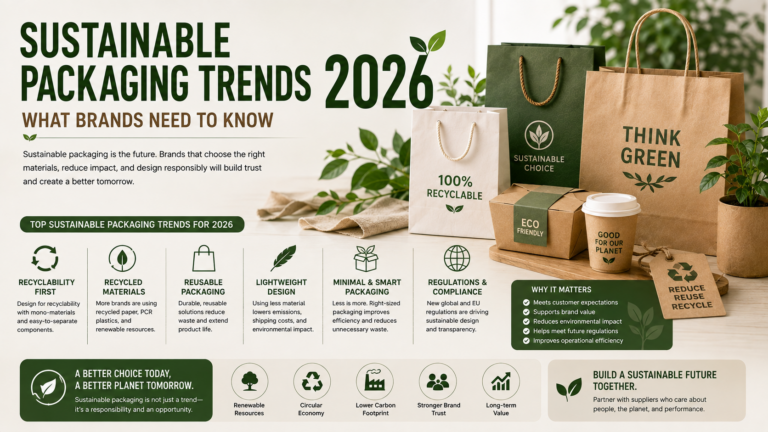

Sustainable packaging is no longer simply a marketing trend. In 2026, it is becoming a much more practical business consideration involving materials, recyclability, packaging efficiency, regulations, logistics, and customer expectations.
For retail brands, restaurants, cosmetics companies, fashion businesses, and other consumer-facing brands, packaging decisions increasingly need to balance three things:
Environmental impact + Brand experience + Commercial performance
At the same time, regulatory requirements are becoming more important. In the EU, the Packaging and Packaging Waste Regulation (PPWR) entered into force in February 2025 and generally begins applying from August 12, 2026, bringing new requirements around recyclability, packaging minimization, reuse, labeling, and recycled content.
So what should brands pay attention to in 2026?
Let’s look at the key sustainable packaging trends shaping the market.
1. Recyclability Is Becoming a Core Packaging Requirement
One of the biggest shifts in sustainable packaging is the move from simply asking:
“Is this material environmentally friendly?”
to asking:
“What happens to this packaging after the customer is finished with it?”
This means brands are increasingly evaluating packaging based on its end-of-life pathway.
Important considerations include:
- Can the packaging be collected?
- Can it be sorted?
- Can it be recycled?
- Are different materials easy to separate?
- Does the packaging contain unnecessary coatings or components?
- Is there sufficient recycling infrastructure in the target market?
The EU’s PPWR is pushing this direction strongly. The regulation aims for packaging placed on the EU market to be recyclable, with broader recyclability requirements developing toward 2030 and beyond.
For brands selling internationally, recyclability should therefore be considered during the design stage, rather than treated as an afterthought.
2. Packaging Minimization Is Becoming More Important
Sustainable packaging does not necessarily mean replacing one material with another.
Sometimes the most sustainable packaging is simply less packaging.
Brands are increasingly looking at:
- Smaller packaging dimensions
- Reduced material usage
- Lower paper weight where appropriate
- Less unnecessary internal packaging
- More efficient bag and box structures
- Reduced empty space
- Fewer unnecessary components
The EU’s new packaging rules specifically promote packaging minimization and aim to reduce unnecessary packaging volume and weight.
This creates an important design principle for brands:
Use enough packaging to protect and present the product, but avoid material that does not add meaningful function.
For custom paper bags, this could mean optimizing the bag dimensions and GSM instead of automatically choosing the thickest paper available.
3. Paper Packaging Continues to Gain Attention
Paper remains an important material for brands looking to move away from certain plastic packaging formats.
Custom paper bags are particularly popular in:
- Retail
- Fashion
- Cosmetics
- Gift packaging
- Food and takeaway
- Events and promotions
Common paper options include:
- Kraft paper
- White card paper
- Recycled paper
- Coated paper
- Specialty papers
However, simply choosing paper does not automatically make a packaging solution sustainable.
Brands should also consider:
- Paper source
- Recycled content
- Bag weight
- Printing
- Coatings
- Finishing
- Handle materials
- End-of-life recyclability
The better approach is to evaluate the entire packaging system, rather than judging sustainability from the material name alone.
4. Recycled Materials Are Moving Into the Mainstream
Recycled content is becoming a more important part of packaging discussions.
For brands, recycled materials can help reduce reliance on virgin resources and support a more circular packaging system.
Depending on the product and market, businesses may explore:
- Recycled paper
- Recycled cardboard
- Recycled plastic
- Recycled textile materials
- Post-consumer recycled content
For plastic packaging, the EU PPWR includes measures to increase the use of recycled content.
However, recycled material should still be evaluated based on the actual application.
Questions to ask include:
- Does the material meet the required strength?
- Is the printing quality sufficient?
- Is the color consistent?
- Can the supplier provide relevant documentation?
- Does the material meet the requirements of the destination market?
Sustainability should never come at the expense of basic packaging performance.
5. Lightweight Packaging Can Reduce Both Material and Logistics Costs
One of the most practical sustainability strategies is lightweighting.
Using less material can potentially reduce:
- Raw material consumption
- Product weight
- Shipping weight
- Transportation emissions
- Storage requirements
For example, a brand may discover that a slightly lighter paper specification is sufficient for its products.
However, lightweighting should be based on performance testing.
The goal is not:
“Use the thinnest possible material.”
The goal is:
“Use the minimum material needed to deliver the required performance.”
This distinction is especially important for B2B packaging projects where bags need to withstand repeated handling or heavy products.
6. Reusable Packaging Is Expanding
Single-use packaging is not the only model available.
For certain applications, reusable packaging can create additional value.
Examples include:
- Reusable shopping bags
- Canvas tote bags
- PP non-woven bags
- Reusable delivery packaging
- Refillable packaging systems
Reusable bags can be particularly effective for:
- Fashion brands
- Supermarkets
- Promotional campaigns
- Corporate events
- Lifestyle brands
But reuse should be evaluated realistically.
A reusable bag needs to be durable enough to actually be reused multiple times.
If a bag is marketed as reusable but is too weak or inconvenient to use again, the environmental value becomes questionable.
The EU’s PPWR also includes requirements and targets related to reusable packaging, reinforcing the broader move toward reuse and refill models.
7. Sustainable Packaging Is Becoming More Design-Driven
Eco-friendly packaging no longer has to look plain.
In 2026, brands are increasingly combining sustainable materials with strong visual identities.
Popular design directions include:
Minimalist Branding
Simple logos, clean typography, and restrained graphics can reduce visual clutter while creating a premium appearance.
Natural Textures
Kraft paper, uncoated surfaces, and natural fibers can communicate a more authentic packaging identity.
Earth-Inspired Color Palettes
Muted greens, beige, brown, cream, and neutral tones are often used to reinforce environmental positioning.
Premium Minimalism
Sustainable packaging does not have to look inexpensive.
A simple paper bag with precise printing, elegant typography, and carefully selected finishing can create a sophisticated brand experience.
The key idea is:
Sustainability and premium branding are not opposites.
8. Mono-Material and Simplified Structures Are Getting More Attention
Packaging made from multiple materials can be difficult to recycle if the components cannot be easily separated.
This has increased interest in:
Simpler material structures.
For example, brands may evaluate whether they really need:
- Multiple layers
- Permanent plastic components
- Complex coatings
- Non-separable accessories
- Unnecessary decorative materials
Simplifying the structure can potentially make packaging easier to sort and process after use.
This approach also aligns with the broader direction of EU packaging policy toward recyclable packaging and clearer material management.
9. Packaging Labels Need to Become Clearer
Sustainable packaging is only useful if customers know what to do with it after use.
Clear labeling can help communicate:
- Material composition
- Recycling instructions
- Disposal instructions
- Reuse instructions
- Applicable certifications
The EU is moving toward more harmonized packaging labeling to make sorting easier for consumers.
For brands selling across multiple European markets, this is particularly important because packaging information may need to work across different countries and languages.
Instead of treating labeling as decoration, brands should consider it part of the packaging’s end-of-life design.
10. Sustainability Claims Need More Evidence
Consumers are becoming more skeptical of vague environmental claims.
Words such as:
- Eco-friendly
- Green
- Sustainable
- Environmentally friendly
- Biodegradable
can create questions if they are not supported by clear information.
For B2B buyers, it is increasingly important to ask suppliers for documentation supporting relevant claims.
Depending on the material and market, this may include:
- Recycled content information
- Paper sourcing documentation
- Relevant certifications
- Material specifications
- Compliance documentation
- Testing reports
The more specific the claim, the more important it is to have evidence behind it.
11. Sustainable Packaging Is Becoming a Supply Chain Issue
Sustainability does not end when the packaging leaves the factory.
Transportation can also influence the overall environmental footprint.
For this reason, brands are paying more attention to:
- Packaging dimensions
- Carton efficiency
- Pallet utilization
- Shipping volume
- Product-to-package ratio
- Supplier location
- Consolidated shipments
For lightweight but bulky products such as paper bags, shipping volume can be particularly important.
A packaging design that uses slightly less material and packs more efficiently can potentially provide benefits beyond the factory floor.
12. Packaging Suppliers Are Becoming Strategic Partners
In the past, packaging procurement often focused on:
“How much does this bag cost?”
In 2026, the conversation is increasingly becoming:
“Can this supplier help us achieve our packaging, sustainability, quality, and compliance goals?”
A capable packaging manufacturer should be able to discuss:
- Material selection
- GSM
- Bag structure
- Recycled materials
- Printing
- Finishing
- Packaging efficiency
- Quality control
- Production lead time
- Shipping
- Documentation
For B2B buyers, this can make supplier selection much more important than simply comparing unit prices.
13. Regulations Are Becoming Part of Packaging Planning
This is particularly important for brands selling in Europe.
The EU PPWR generally begins applying on August 12, 2026. It covers packaging and packaging waste across materials and addresses areas including recyclability, packaging minimization, reuse, labeling, and waste prevention.
The European Commission has also published 2026 guidance to help businesses and authorities interpret the regulation.
This means packaging buyers should increasingly consider compliance during product development rather than waiting until the packaging is already in production.
A practical approach is to ask:
Where will this packaging be sold?
What regulations apply there?
What documentation will we need?
Could the packaging design create compliance problems later?
For companies selling internationally, these questions can save significant time and cost.
14. The Best Sustainable Packaging Is Application-Specific
There is no universal material that is automatically the most sustainable choice for every business.
A fashion retailer may prefer custom paper bags.
A promotional agency may benefit from reusable non-woven bags.
A premium brand may choose canvas.
A food business may need packaging with specific performance and food-contact requirements.
The right choice depends on:
- Product
- Usage
- Required durability
- Expected lifespan
- Customer behavior
- Recycling infrastructure
- Regulations
- Shipping
- Total cost
Sustainability should therefore be treated as a system-level decision, not a material trend.
How Brands Can Prepare for Sustainable Packaging in 2026
If your company is reviewing its packaging strategy this year, consider the following steps.
Step 1: Audit Your Current Packaging
Look at:
- Material
- Weight
- Size
- Components
- Recyclability
- Reusability
- Shipping efficiency
Step 2: Identify Unnecessary Material
Ask:
Can we use less without compromising performance?
Step 3: Evaluate Alternative Materials
Compare:
- Virgin vs recycled paper
- Paper vs reusable non-woven
- Single-use vs reusable options
- Different GSM levels
Step 4: Simplify the Structure
Reduce unnecessary layers, components, and difficult-to-separate materials where practical.
Step 5: Review Your Packaging Claims
Make sure environmental claims are specific and supported by appropriate documentation.
Step 6: Check Market Requirements
Especially if you sell into the EU, review the latest applicable packaging requirements and implementation guidance.
Step 7: Test Before Scaling
Request samples and evaluate:
- Strength
- Appearance
- Printing
- Functionality
- Packaging efficiency
Sustainability should be validated in the real world, not only in a product specification sheet.
Sustainable Packaging Checklist for Brands
Before ordering your next packaging project, ask:
- Can we reduce the amount of material?
- Is the packaging appropriately sized?
- Is the material recyclable in the target market?
- Can recycled content be used?
- Can unnecessary components be removed?
- Is the packaging durable enough for its intended use?
- Can it realistically be reused?
- Are sustainability claims supported by documentation?
- Is the packaging efficiently packed for transportation?
- Does it meet applicable market requirements?
- Can the supplier provide consistent quality?
- Can the packaging be scaled for future orders?
Conclusion
The biggest sustainable packaging trend in 2026 is not simply the replacement of one material with another.
It is a broader shift toward better packaging decisions.
Brands are increasingly looking at the entire packaging lifecycle:
Material → Design → Production → Transportation → Use → Reuse or Recycling → End of Life
Recyclability, material efficiency, recycled content, reusable formats, simpler structures, clearer labeling, and regulatory compliance are all becoming more important.
For businesses, the opportunity is bigger than simply reducing waste. Better packaging design can also improve logistics efficiency, brand perception, purchasing decisions, and long-term packaging costs.
If you are planning new custom packaging in 2026, the best time to consider sustainability is before production begins.
Looking for sustainable custom packaging for your business? We provide custom paper bags, PP non-woven bags, canvas bags, and other packaging solutions with material recommendations, custom printing, professional design support, bulk production, quality control, and global shipping for B2B buyers.