
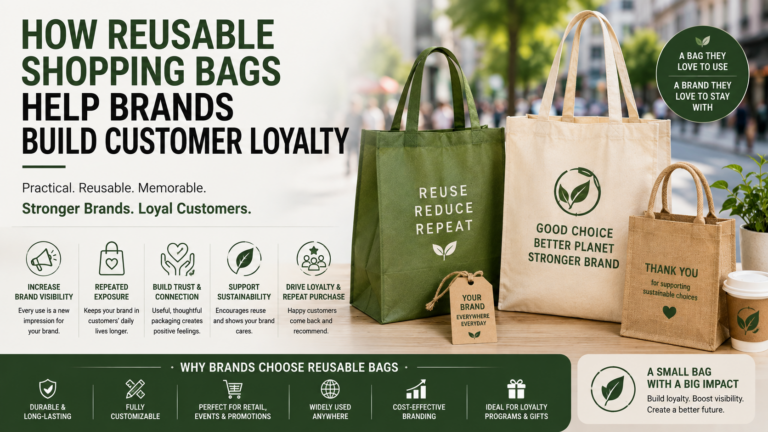

Customer loyalty is rarely built through a single advertisement or one-time promotion.
It develops through repeated interactions.
A customer sees a brand, purchases a product, uses the product, interacts with its packaging, remembers the experience, and eventually decides whether to return.
This is where reusable shopping bags can become surprisingly valuable.
A well-designed reusable bag is more than a way to carry products home. It can become a physical reminder of the brand, a mobile branding tool, and an additional reason for customers to keep interacting with the business.
For retail brands, supermarkets, fashion companies, lifestyle businesses, promotional agencies, and event organizers, reusable bags can connect packaging, branding, sustainability, and customer retention in one product.
So how exactly do reusable shopping bags help build customer loyalty?
1. Reusable Bags Keep the Brand in Customers’ Daily Lives
Traditional packaging often has a very short lifespan.
A customer buys a product, carries it home, and the packaging is eventually discarded.
A reusable shopping bag can follow a completely different path.
If the bag is durable and attractive, customers may use it for:
- Grocery shopping
- Gym visits
- Work
- Travel
- Weekend shopping
- Picnics
- Events
- Everyday errands
Every additional use creates another brand exposure.
Imagine a customer buys clothing from a fashion retailer and receives a high-quality custom tote bag.
The customer later uses that bag at a supermarket.
Someone sees the logo.
A few days later, the same customer takes it to work.
The brand continues to travel even though the original purchase has already ended.
This gives reusable packaging a powerful characteristic:
The marketing doesn’t necessarily stop when the customer leaves the store.
2. Reusable Bags Turn Packaging Into a Long-Term Marketing Asset
Traditional advertising has an obvious limitation: brands have to keep paying for exposure.
Reusable bags work differently.
Once produced and distributed, a branded bag can potentially generate impressions repeatedly without requiring additional advertising spend for every use.
This makes reusable bags particularly interesting for brands that depend on local visibility.
A simple logo, website, slogan, or distinctive graphic can turn the bag into a small mobile billboard.
For example, a custom tote might display:
Brand Logo
Website
Instagram
Brand Slogan
Every time the bag is carried in public, these elements can be seen by new people.
For businesses with physical stores, this can help reinforce local brand recognition.
3. Customers Keep Products That Have Practical Value
A reusable bag needs to earn its place in the customer’s life.
If it is weak, awkward, or uncomfortable to carry, it may quickly disappear into a drawer.
If it is useful, the story changes.
Customers are more likely to keep using a bag that offers:
- Strong handles
- Comfortable carrying
- Appropriate capacity
- Durable material
- Practical dimensions
- Attractive design
This is why functionality is part of branding.
A customer may not consciously think:
“This bag is strengthening my relationship with this brand.”
But every positive interaction reinforces familiarity with the company.
4. Good Design Can Increase Perceived Brand Value
Reusable bags provide a relatively large surface for visual branding.
Compared with small product labels or receipts, a shopping bag can provide much more room for design.
Brands can customize:
- Bag color
- Logo
- Typography
- Patterns
- Illustrations
- Handles
- Material
- Size
- Finishing
For premium brands, even simple designs can create a sophisticated effect.
For example:
Minimalist Fashion Brand
A neutral-colored canvas tote with a small logo can communicate understated premium positioning.
Lifestyle Brand
A bold graphic and distinctive slogan can make the bag feel like a branded accessory.
Supermarket
A practical reusable bag with a recognizable logo can increase everyday brand visibility.
Event Organizer
A custom tote can become a useful souvenir long after the event ends.
The bag becomes part of the brand’s visual language.
5. Reusable Bags Can Strengthen Sustainability Positioning
Sustainability has become an increasingly important part of brand perception.
Customers may pay attention to how businesses handle:
- Packaging
- Waste
- Materials
- Reuse
- Recycling
Reusable shopping bags can support a brand’s sustainability strategy by encouraging repeated use rather than treating packaging as disposable.
However, brands should be careful with environmental claims.
A reusable bag is not automatically a sustainable solution simply because it can technically be reused.
Its environmental value depends on factors such as:
- Material
- Durability
- Number of actual uses
- Production
- Transportation
- End-of-life options
The practical goal should be to create a bag that customers actually want to reuse.
6. Reuse Creates More Customer Touchpoints
Customer loyalty is built through repeated interactions.
A reusable bag creates opportunities for those interactions.
The customer might:
Purchase → Carry → Reuse → See Logo → Remember Brand → Visit Again
That repeated exposure can strengthen brand familiarity.
This is particularly useful for businesses with frequent purchasing cycles.
For example:
- Supermarkets
- Fashion retailers
- Cafés
- Beauty stores
- Lifestyle shops
- Bookstores
- Specialty retailers
The more frequently the bag is used, the more frequently the brand enters the customer’s everyday environment.
7. Reusable Bags Can Encourage Repeat Purchases
A reusable bag alone cannot guarantee customer loyalty.
But it can support a broader retention strategy.
For example, a retailer might provide a branded reusable bag with a purchase and connect it to:
- Loyalty programs
- Member discounts
- Seasonal campaigns
- Referral programs
- Product launches
- VIP events
The bag becomes one physical element within a larger customer experience.
A brand might even create limited-edition bags for different seasons or collections.
This can give customers a reason to collect, reuse, or share them.
8. Limited-Edition Bags Can Create Collectability
Not every reusable bag needs to look identical.
Brands can create different designs for:
- Seasonal campaigns
- Product launches
- Collaborations
- Anniversaries
- Events
- Holidays
- Special collections
For example, a fashion brand could release a limited-edition tote for a new collection.
Customers who already know the brand may want the new design simply because it feels different from the standard packaging.
This changes the role of the bag from:
Packaging
to:
Branded merchandise.
That shift can significantly increase its perceived value.
9. Reusable Bags Can Create Social Visibility
Some reusable bags are used in highly visible environments.
A customer carrying a distinctive tote through a shopping district is effectively displaying the brand.
This can generate organic exposure among:
- Friends
- Colleagues
- Other shoppers
- Event attendees
- Local communities
The effect becomes stronger when the bag has a distinctive visual identity.
A generic bag may disappear into the crowd.
A well-designed branded bag can become recognizable.
10. Different Materials Create Different Brand Experiences
Reusable shopping bags are not limited to one material.
Popular options include:
PP Non-Woven Bags
Often chosen for:
- Retail promotions
- Supermarkets
- Events
- Promotional campaigns
- Large-volume distribution
They can provide a practical balance between durability, customization, and cost.
Canvas Bags
Often associated with:
- Lifestyle brands
- Fashion
- Premium promotions
- Corporate gifting
- Long-term reuse
Canvas can create a more substantial and premium tactile experience.
Cotton Bags
Suitable for brands looking for a natural textile appearance and comfortable everyday use.
The right material should be selected based on:
Expected lifespan + product positioning + budget + usage scenario.
11. The Bag Can Become Part of the Unboxing Experience
Reusable bags can also influence how customers perceive the purchase at the moment of delivery.
Imagine two scenarios.
Scenario A
The customer receives a thin disposable bag with minimal branding.
Scenario B
The customer receives a durable custom tote with carefully designed graphics and comfortable handles.
The second experience can feel more intentional.
This matters especially for:
- Fashion
- Cosmetics
- Jewelry
- Lifestyle
- Premium gifts
When packaging feels valuable, customers may perceive the product and brand as more valuable too.
12. Reusable Bags Can Support Omnichannel Branding
Modern brands often sell through multiple channels:
- Physical stores
- E-commerce
- Pop-up stores
- Events
- Marketplaces
- Wholesale partners
Reusable bags can help create a consistent visual identity across these touchpoints.
For example, the same:
- Logo
- Brand color
- Typography
- Graphic style
can appear across packaging, website materials, social media, and physical bags.
This consistency helps customers recognize the brand more easily.
13. Quality Matters More Than Simply Calling a Bag “Reusable”
One of the biggest mistakes brands can make is focusing on the word reusable while ignoring actual performance.
A reusable bag should be designed for its intended load and usage.
Consider:
Handle Strength
Can customers comfortably carry the expected weight?
Material Durability
Will the bag survive repeated use?
Bottom Construction
Can it handle the products without tearing or deforming?
Size
Is it large enough to be useful but not unnecessarily bulky?
Cleaning
For certain applications, can the material be reasonably maintained?
A bag that customers use repeatedly is far more valuable than a “reusable” bag that gets used once.
14. The Right Order Quantity Matters
For B2B buyers, reusable bags are often ordered in significant quantities.
Before placing an order, consider:
- Monthly demand
- Campaign duration
- Number of stores
- Expected customer traffic
- Seasonal demand
- Storage space
- MOQ
- Unit price
Ordering too few bags can create stock shortages.
Ordering too many can tie up cash and warehouse space.
For large retail networks, it can be useful to forecast demand by store and campaign period before confirming the production quantity.
15. Customization Can Make the Bag More Memorable
A generic reusable bag may be useful.
A distinctive reusable bag can be memorable.
Brands can experiment with:
- Unique colors
- Oversized logos
- Minimalist graphics
- Slogans
- Illustrations
- Patterned designs
- Special handles
- Seasonal artwork
The key is to make the design recognizable without making it visually overwhelming.
The strongest packaging often gives customers a reason to want to carry it.
That is when packaging begins to behave more like merchandise.
16. Reusable Bags Can Support Customer Loyalty Programs
Brands can integrate reusable bags directly into loyalty initiatives.
For example:
Spend $100 → Receive a premium branded tote
or:
Members receive an exclusive seasonal bag
or:
Bring your branded bag back → Receive a small discount
These strategies turn the reusable bag into part of the customer retention mechanism.
The bag is no longer just something the customer receives.
It becomes part of an ongoing relationship.
17. Reusable Bags Can Support Corporate and Event Branding
Customer loyalty isn’t limited to retail stores.
Reusable bags can also work well for:
- Trade shows
- Conferences
- Corporate events
- Product launches
- Employee programs
- Client gifting
- Promotional campaigns
A high-quality tote can continue to be used long after the event ends.
For B2B companies, this provides an additional branding opportunity outside traditional promotional products.
How to Design a Reusable Bag That Customers Actually Want to Keep
A successful reusable shopping bag should combine function and identity.
Consider the following design principles.
1. Make It Useful
Choose dimensions that work for real everyday activities.
2. Make It Durable
Select material and construction according to expected load.
3. Make It Comfortable
Pay attention to handle length, width, and attachment.
4. Make It Recognizable
Use consistent brand colors, logos, and design elements.
5. Avoid Overdesign
A simple, well-balanced design can have greater long-term appeal.
6. Match the Brand Positioning
A luxury fashion brand may require a very different bag from a supermarket.
7. Think About Long-Term Use
Ask yourself:
Would a customer still want to carry this bag six months from now?
If the answer is yes, the bag has already passed an important branding test.
Reusable Shopping Bag Checklist for Brands
Before ordering, consider:
- Target customer
- Intended use
- Material
- Bag size
- GSM or material thickness
- Handle type
- Handle strength
- Bottom construction
- Printing
- Brand colors
- Sustainability requirements
- Expected number of uses
- Order quantity
- MOQ
- Storage requirements
- Production lead time
A detailed specification helps ensure the finished bag delivers both functional and branding value.
Conclusion
Reusable shopping bags can play a surprisingly important role in customer loyalty.
They can extend brand exposure beyond the point of purchase, create repeated customer touchpoints, support sustainability positioning, strengthen brand recognition, and become part of the overall shopping experience.
But the key is reuse.
A bag that customers genuinely want to keep and use can create much more value than packaging designed only for a single trip.
For brands, the goal should therefore be more ambitious than simply producing a reusable bag.
It should be to create a bag that customers recognize, value, use, and remember.
When packaging becomes something customers willingly carry again and again, every shopping trip can become another small interaction with your brand.
Looking for custom reusable bags for your business? We provide custom PP non-woven bags, canvas bags, cotton bags, and other reusable packaging solutions with professional design support, custom printing, bulk production, quality control, and global shipping for B2B buyers. Contact us to discuss your requirements and request a customized quotation.