
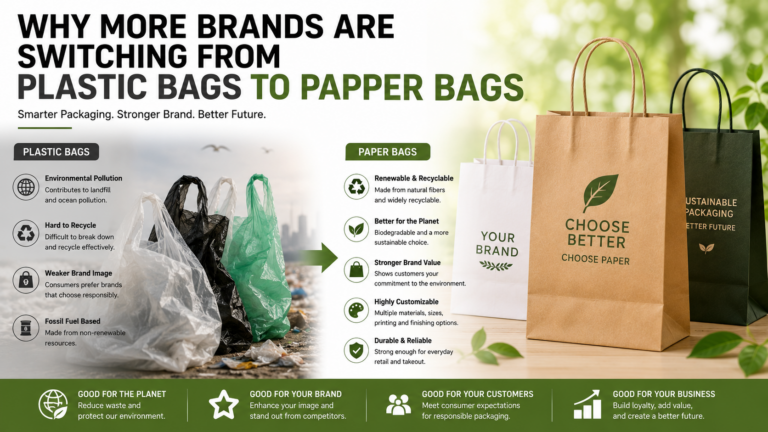

For decades, plastic bags were one of the most common packaging solutions for retail stores, supermarkets, restaurants, fashion brands, and promotional campaigns.
They were lightweight, inexpensive, water-resistant, and easy to manufacture.
But packaging expectations are changing.
Today, more brands are reconsidering the role of plastic bags and exploring paper bags as an alternative packaging solution. The shift is being driven by changing consumer expectations, sustainability goals, packaging regulations, brand positioning, and the growing demand for recyclable packaging.
For B2B buyers, however, switching from plastic to paper is not simply a material replacement. Brands need to consider strength, cost, product protection, logistics, printing, recyclability, and the actual application.
So why are more brands making the switch?
1. Sustainability Is Becoming Part of the Purchasing Decision
Sustainability has moved beyond a niche concern.
For many brands, packaging is one of the most visible physical touchpoints between the company and the customer.
A customer may never see how a product was manufactured, but they will see the bag that carries it out of the store.
This makes packaging an important opportunity for brands to communicate their environmental positioning.
Paper bags can support this strategy because paper is a fiber-based material that is widely recyclable in many markets, subject to local collection and recycling systems.
Brands can therefore use packaging design to communicate a more responsible approach to material selection.
However, it is important not to treat paper as automatically sustainable in every situation. The actual environmental impact depends on factors such as:
- Material sourcing
- Paper weight
- Manufacturing
- Transportation
- Reuse
- Recycling infrastructure
- Printing and finishing
- Product lifespan
The better question is not simply “Paper or plastic?”
It is:
“Which packaging solution delivers the required performance with the appropriate environmental and commercial profile?”
2. Paper Bags Can Strengthen Brand Image
Packaging is part of the customer experience.
A well-designed paper bag can function as a portable brand advertisement long after the customer leaves a store.
Consider a premium fashion store.
A customer carrying a carefully designed paper bag with:
- A distinctive logo
- High-quality printing
- Premium paper
- Custom handles
- Minimalist graphics
is effectively carrying the brand into public spaces.
This can create additional brand exposure without requiring another advertising channel.
For fashion, cosmetics, jewelry, lifestyle, and gift brands, this visual aspect can be particularly valuable.
3. Paper Bags Offer Strong Customization Options
Custom paper bags can be produced in a wide range of specifications.
Brands can customize:
- Size
- Shape
- Paper material
- GSM
- Handle type
- Handle color
- Logo
- Printing
- Surface finish
- Foil stamping
- Embossing
- Debossing
This allows businesses to create packaging that matches their brand identity.
For example:
Fashion Brand
A white paper bag with minimalist typography and rope handles can create a premium appearance.
Café
A kraft paper bag with a simple printed logo can create a natural, casual brand identity.
Cosmetics Brand
A coated paper bag with detailed printing and foil finishing can reinforce a luxury positioning.
Corporate Event
A custom printed paper bag can turn event packaging into a promotional tool.
The packaging becomes more than a container. It becomes part of the visual identity.
4. Paper Bags Are Well Suited to Retail Packaging
Retail is one of the biggest applications for custom paper bags.
They can be used for:
- Clothing
- Shoes
- Accessories
- Cosmetics
- Gifts
- Books
- Jewelry
- Lifestyle products
- Specialty retail
Retail brands often need packaging that balances three requirements:
Functionality + Appearance + Brand Visibility
Paper bags can provide all three when properly designed.
The bag can carry the product while simultaneously displaying the brand logo and visual identity.
5. Consumers See the Packaging Immediately
Packaging is one of the few marketing materials that customers physically interact with after purchasing a product.
Think about the customer journey:
Store → Purchase → Carry → Transport → Reuse or Dispose
The bag is present throughout this journey.
A branded paper bag can therefore create multiple impressions after the actual purchase.
A customer might carry it:
- Through a shopping mall
- On public transportation
- Into an office
- To a friend’s home
- Around a city
Every exposure creates another opportunity for the brand to be seen.
This makes a custom paper bag a surprisingly useful offline marketing asset.
6. Paper Bags Can Be Reused
Not every paper bag is designed for multiple uses, but appropriately constructed paper bags can be reused.
Durability depends on:
- Paper GSM
- Bag dimensions
- Handle construction
- Bottom structure
- Reinforcement
- Product weight
A lightweight bag designed for a small purchase has different requirements from a reinforced bag carrying clothing, shoes, or bottles.
Brands that want customers to reuse their bags should therefore consider durability during the design stage.
A stronger bag may have a higher initial cost, but it can also provide greater functionality and longer use.
7. The Right Paper Bag Can Handle Heavy Products
One common misconception is that paper bags are only suitable for lightweight products.
In reality, custom paper bags can be engineered for different load requirements.
For heavier applications, manufacturers can adjust:
- Paper GSM
- Bag dimensions
- Bottom construction
- Handle material
- Handle attachment
- Reinforcement
For example, wine and spirits packaging may require reinforced structures and stronger handles.
A cosmetic retailer may need moderate strength, while a fashion retailer may prioritize appearance and carrying comfort.
The important point is that bag performance should be designed around the product.
8. Paper Bags Work Well With Premium Printing
Paper provides a versatile surface for branding.
Depending on the selected material and production method, brands can create:
- Solid colors
- Detailed graphics
- Minimalist logos
- Patterns
- Illustrations
- Metallic effects
- Foil details
This gives designers considerable freedom.
A kraft paper bag can create a natural visual identity.
White paper can provide a clean background for brand colors.
Coated paper can create a smoother, more premium appearance.
The material and printing method should therefore be selected together.
9. Packaging Regulations Are Influencing Material Choices
Regulation is another factor behind changes in packaging strategy.
Governments and regional authorities are increasingly focusing on:
- Packaging waste
- Recyclability
- Packaging reduction
- Recycled content
- Reuse
- Waste management
For brands selling internationally, packaging requirements can differ significantly between markets.
The European Union’s Packaging and Packaging Waste Regulation is one example of the broader regulatory shift toward more sustainable packaging systems.
This means packaging decisions increasingly need to consider not only:
“What does the customer want?”
but also:
“What requirements will this packaging need to meet in our target markets?”
Brands should work with packaging suppliers that can provide accurate material specifications and relevant documentation.
10. Paper Bags Can Support More Efficient Packaging Design
Switching materials does not automatically make packaging better.
Brands should also look at the overall packaging design.
For example, unnecessary material can increase:
- Manufacturing costs
- Shipping volume
- Storage requirements
- Material consumption
A properly sized paper bag can reduce unnecessary material while still providing sufficient space for the product.
Businesses can optimize:
- Bag width
- Bag height
- Gusset depth
- GSM
- Handle length
- Carton packing
This approach can improve both cost efficiency and resource efficiency.
11. Paper Bags Can Be Part of a Broader Packaging Strategy
Successful brands rarely rely on a single packaging format.
Instead, they may use different solutions for different applications.
For example:
| Application | Possible Packaging |
|---|---|
| Everyday retail | Kraft paper bags |
| Fashion | Premium paper bags |
| Cosmetics | White/coated paper bags |
| Heavy bottles | Reinforced paper bags |
| Promotional events | Non-woven bags |
| Long-term reuse | Canvas tote bags |
This is a more practical approach than trying to use one material for every product.
The right packaging depends on the product, customer experience, budget, and intended lifespan.
12. Paper Bags Can Help Brands Create a Premium Unboxing Experience
Packaging doesn’t end when the customer receives the product.
It can also influence how the product is perceived.
For premium brands, details such as:
- Paper texture
- Bag structure
- Handle quality
- Printing precision
- Foil stamping
- Embossing
- Color consistency
can all contribute to perceived value.
A well-designed bag can make a relatively simple product feel more carefully presented.
This is particularly important for:
- Beauty brands
- Fashion labels
- Jewelry stores
- Luxury retailers
- Gift companies
In these industries, packaging is often part of the product experience itself.
13. Switching From Plastic Doesn’t Mean Ignoring Cost
Cost remains critical for B2B buyers.
Paper bags can have different costs depending on:
- Paper material
- GSM
- Size
- Printing
- Handle
- Finishing
- Quantity
- MOQ
- Packaging
- Shipping
A simple kraft paper bag with one-color printing may be significantly different in cost from a premium coated paper bag with foil stamping and rope handles.
For large-volume buyers, the best strategy is to request quotations at several quantities.
For example:
1,000 / 3,000 / 5,000 / 10,000 pieces
Then compare the unit price with:
- Expected usage
- Inventory
- Storage
- Shipping
- Cash flow
The cheapest unit price isn’t always the cheapest overall solution.
14. Paper vs. Plastic: There Is No One-Size-Fits-All Answer
It is important to avoid oversimplifying the discussion.
Plastic bags still have practical advantages in some applications.
They can offer:
- Low weight
- Moisture resistance
- High flexibility
- Low material usage
- High strength-to-weight performance
For certain products and applications, plastic may still be the more practical solution.
Paper bags can offer advantages in areas such as:
- Fiber-based material
- Custom printing
- Brand presentation
- Recyclability where infrastructure supports it
- Premium retail appearance
Therefore, businesses should evaluate the full life cycle and intended use rather than assuming one material is automatically better.
15. How to Make the Switch Successfully
If your business is considering moving from plastic bags to paper bags, don’t change the material overnight.
Start with a packaging audit.
Step 1: Identify Current Applications
Determine which products currently use plastic bags.
Step 2: Measure Product Weight
Record the average and maximum load.
Step 3: Define Bag Dimensions
Choose dimensions based on actual product sizes.
Step 4: Select Paper Material
Compare kraft, white card, recycled, or coated paper based on the application.
Step 5: Choose the Structure
Consider the bottom, gusset, reinforcement, and handle.
Step 6: Design the Branding
Create artwork that reflects your brand identity.
Step 7: Request Samples
Test:
- Strength
- Handle durability
- Dimensions
- Printing
- Appearance
- Carrying comfort
Step 8: Test With Real Products
A bag that looks excellent on a screen may perform differently in actual use.
Step 9: Compare Total Cost
Include manufacturing, packaging, shipping, and inventory costs.
Step 10: Scale After Testing
Once the specification is confirmed, move to larger production quantities.
What Should Brands Consider Before Switching?
Before replacing plastic bags with paper bags, ask:
- What products will the bag carry?
- How heavy are the products?
- Will the bags be reused?
- What paper GSM is appropriate?
- Is the bag size optimized?
- Does the handle need reinforcement?
- What printing quality is required?
- Is recycled paper suitable?
- What finishing is necessary?
- What are the applicable regulations?
- How will the bags be shipped?
- What is the total landed cost?
These questions help ensure the switch is based on business requirements rather than simply following a trend.
The Future of Retail Packaging Is About Better Choices
The shift from plastic bags to paper bags reflects a broader change in how brands think about packaging.
Packaging is increasingly expected to do several jobs at once:
Protect the product.
Represent the brand.
Meet customer expectations.
Control costs.
Support sustainability goals.
Fit regulatory requirements.
Paper bags can be an effective solution for many retail and promotional applications, but the best results come from thoughtful specification rather than simply choosing paper because it sounds more sustainable.
For B2B buyers, the key is to work backward from the actual application.
Start with the product. Define the performance requirements. Select the material. Optimize the structure. Then design the branding.
That approach creates packaging that is not only visually appealing, but also practical, commercially viable, and better aligned with the brand’s long-term packaging strategy.
Conclusion
More brands are switching from plastic bags to paper bags because packaging is changing from a purely functional item into a strategic part of brand, sustainability, and customer experience.
Paper bags can offer strong customization, attractive branding opportunities, recyclable fiber-based formats in appropriate waste systems, and a premium retail presentation.
But the right choice depends on the application.
For businesses considering the switch, the goal should not simply be to replace plastic with paper.
It should be to develop a better-performing, better-designed, and more responsible packaging solution.
Looking for custom paper bags for your business? We provide custom paper bags for retail, fashion, cosmetics, food, gifts, events, and other B2B applications, with professional design support, material recommendations, custom printing, bulk production, quality control, and global shipping. Contact us to discuss your packaging requirements and request a quotation.