
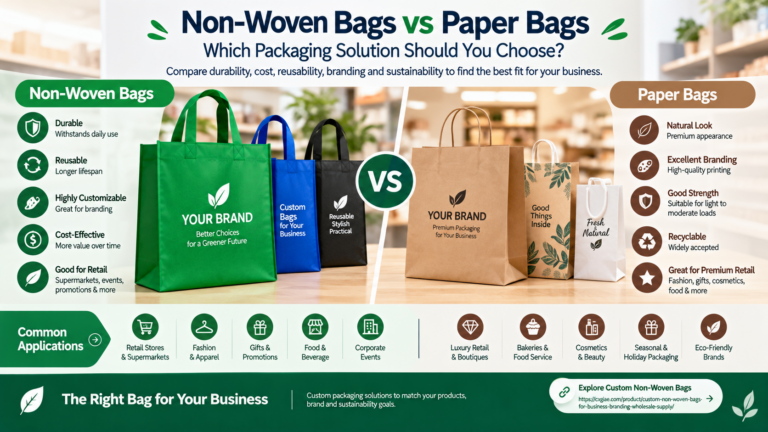

Choosing the right packaging bag is an important decision for retailers, brands, restaurants, supermarkets, and promotional businesses.
Two popular options are non-woven bags and paper bags.
Paper bags are widely used for retail packaging because they offer a natural appearance, strong branding potential, and a familiar customer experience. Non-woven bags, on the other hand, are designed for repeated use and can provide greater durability, flexibility, and long-term promotional value.
So which one should your business choose?
The answer depends on more than material preference.
Buyers should consider product weight, intended use, reusability, branding, cost, durability, customer expectations, storage, transportation, and local packaging requirements before making a decision.
This guide compares non-woven bags and paper bags from a practical B2B purchasing perspective.
Non-Woven Bags vs Paper Bags: Quick Comparison
| Factor | Non-Woven Bags | Paper Bags |
|---|---|---|
| Main material | PP non-woven fabric | Kraft, white card, coated or specialty paper |
| Reusability | Excellent | Usually limited |
| Durability | Good to excellent depending on specification | Good, but depends on paper and construction |
| Water resistance | Better, especially with lamination | Limited unless specially treated |
| Branding | Excellent | Excellent |
| Printing | Highly customizable | Highly customizable |
| Premium appearance | Good to excellent | Excellent |
| Cost per piece | Low to medium | Low to medium, depending on material |
| Cost per use | Potentially low with repeated use | Higher if used once |
| Storage | Foldable and compact | Stackable and relatively compact |
| Heavy products | Suitable with correct construction | Suitable when properly specified |
| Promotional use | Excellent | Good |
| Everyday retail | Excellent | Excellent |
| Repeated shopping | Excellent | Limited to moderate |
| Best strength | Reusability and durability | Presentation and retail appearance |
Neither material is automatically the winner.
Instead, each one solves a different packaging problem.
What Are Non-Woven Bags?
Non-woven bags are commonly made from polypropylene (PP) non-woven fabric.
The material is produced by bonding fibers together rather than weaving traditional threads into a fabric structure.
This creates a lightweight material that can be converted into a wide range of reusable bags.
Common non-woven bag options include:
- Shopping bags
- Promotional tote bags
- Foldable bags
- Gusseted bags
- Box-style bags
- Die-cut handle bags
- Loop-handle bags
- Laminated non-woven bags
- Reinforced heavy-duty bags
Businesses can customize the bags according to their requirements, including:
- Size
- Color
- GSM
- Handle style
- Construction
- Printing
- Lamination
- Reinforcement
- Packaging
Because the material is lightweight and relatively durable, non-woven bags are commonly used when a business wants a reusable carrier that can continue to display its branding after the original purchase.
What Are Paper Bags?
Paper bags are made from paper-based materials and are widely used across retail and food-service applications.
Depending on the brand positioning and product requirements, businesses can choose from materials such as:
- Kraft paper
- White card paper
- Coated paper
- Specialty paper
Paper bags can also be produced in many different formats:
- Retail shopping bags
- Gift bags
- Takeaway bags
- Wine bags
- Bakery bags
- Food-service bags
- Promotional bags
- Luxury shopping bags
Paper provides a particularly useful surface for branding.
Businesses can customize:
- Logo printing
- Full-color graphics
- Paper color
- Handle type
- Bag size
- Finishing
- Surface effects
- Reinforcement
This makes paper bags especially attractive for retailers where packaging appearance is an important part of the customer experience.
1. Reusability: Non-Woven Bags Have the Advantage
The biggest functional difference between the two materials is reusability.
A well-designed non-woven bag can be used repeatedly for shopping, commuting, storage, events, and promotional activities.
Paper bags can also be reused, particularly when they are well constructed and kept dry. However, their practical lifespan is generally more limited than that of a reusable non-woven bag.
For retailers, this creates two different packaging strategies.
Paper bag strategy
Purchase → Carry product home → Potentially reuse → Eventually discard or recycle
Non-woven strategy
Purchase → Carry product home → Reuse repeatedly → Continue carrying products and displaying the brand
If repeated use is one of your main purchasing requirements, non-woven bags deserve serious consideration.
The environmental advantage of reusable packaging also depends on whether customers actually reuse it. Life-cycle studies consistently show that the number of uses can significantly affect the overall environmental performance of different bag types.
2. Durability: Which Bag Is Stronger?
There is no simple answer because durability depends heavily on the specification.
For non-woven bags, strength can be influenced by:
- GSM
- Fabric quality
- Handle construction
- Stitching
- Bottom structure
- Gussets
- Reinforcement
- Lamination
- Overall dimensions
A lightweight promotional bag will obviously perform differently from a reinforced heavy-duty shopping bag.
Paper bags also vary considerably.
A paper bag made from lightweight paper with a simple construction will have different performance from a heavy paper bag with reinforced handles, a wide bottom gusset, and strong paper stock.
Therefore, buyers should not compare materials based only on the words “paper” and “non-woven.”
Instead, compare the complete bag specification.
3. Weight Capacity Matters More Than Material Name
Retail buyers often ask:
“Which is stronger, paper or non-woven?”
A better question is:
“How much weight does the finished bag need to carry?”
For example, a fashion retailer selling lightweight clothing may not need a heavy-duty construction.
A supermarket carrying canned food, bottles, or packaged groceries may need:
- Higher GSM
- Reinforced handles
- Stronger stitching
- Gussets
- A reinforced bottom
- Larger dimensions
Similarly, a paper bag for wine bottles needs a completely different specification from a small cosmetics shopping bag.
The bag should be designed around the product.
4. Branding: Both Options Perform Well
One of the reasons both materials remain popular is their branding potential.
A shopping bag can become a moving advertisement for a retail business.
A customer may carry the bag:
- Through a shopping district
- On public transportation
- To the office
- To another store
- To a restaurant
- To a friend’s home
- To another shopping trip
This creates additional brand exposure.
Paper Bags
Paper bags are particularly suitable for:
- Luxury retail
- Fashion
- Cosmetics
- Jewelry
- Gifts
- Bakeries
- Specialty food
- Premium restaurants
Their paper surface and finishing options can create a sophisticated retail presentation.
Non-Woven Bags
Non-woven bags are particularly suitable for:
- Supermarkets
- Promotional campaigns
- Trade shows
- Corporate events
- Retail chains
- Grocery shopping
- Reusable shopping programs
Their larger reusable format can provide long-term brand visibility.
So when it comes to branding, there is no clear winner.
The better option depends on the image your brand wants to communicate.
5. Premium Appearance: Paper Bags Often Have the Edge
If packaging is a major part of the customer experience, paper can offer a strong visual advantage.
A premium paper bag can combine:
- High-quality printing
- Elegant paper texture
- Custom handles
- Matte or specialty finishes
- Embossing
- Foil effects
- Carefully selected colors
- Structured construction
This makes paper bags particularly attractive for premium retail environments.
For example:
A luxury fashion store may prefer a rigid-feeling paper bag with a sophisticated logo and premium handles.
A supermarket may prefer a reusable non-woven bag that prioritizes durability and repeated use.
Both can be branded effectively, but the desired brand image is different.
6. Moisture Resistance: Non-Woven Bags Are More Flexible
One limitation of ordinary paper bags is their sensitivity to moisture.
If a paper bag becomes wet, its strength can decrease significantly.
This matters for businesses selling:
- Fresh food
- Frozen products
- Bottled drinks
- Groceries
- Outdoor products
- Products exposed to rain during transportation
Non-woven PP fabric naturally handles moisture better than ordinary paper.
Laminated non-woven bags can provide an additional surface barrier and are often selected when appearance and moisture resistance are both important.
However, this does not mean every non-woven bag is waterproof.
The exact performance depends on the fabric, construction, lamination, seams, and design.
7. Cost: Look Beyond the Unit Price
Paper bags can be highly cost-effective for many retail applications.
Non-woven bags generally have a higher upfront cost than lightweight paper bags when comparing similar sizes and order quantities.
But B2B buyers should avoid evaluating reusable packaging only by its purchase price.
Consider:
Cost per use = Purchase cost ÷ Number of meaningful uses
For example, a reusable non-woven bag may cost more initially but continue to be used for many shopping trips.
A paper bag may have a lower unit price but may only be used for one or a small number of shopping trips.
This means the more important question may be:
What value does the bag deliver over its useful life?
For a promotional campaign, the bag can also generate advertising exposure.
For a supermarket, it can encourage repeat shopping use.
For a fashion brand, it can become part of the overall customer experience.
8. Sustainability: The Answer Is More Complicated Than “Paper Is Better”
Paper is often perceived as the obvious sustainable choice because it is fiber-based and can be recycled in many systems.
However, packaging sustainability cannot be determined by material alone.
Important factors include:
- Raw material sourcing
- Manufacturing
- Energy consumption
- Water consumption
- Transportation
- Bag weight
- Number of uses
- Recycling infrastructure
- End-of-life treatment
A life-cycle assessment conducted for Singapore found that replacing disposable bags with other disposable materials does not automatically produce a better environmental outcome. The study emphasized the importance of reducing disposable consumption and reusing bags.
Another study comparing grocery-bag alternatives in Singapore found that reusable polypropylene non-woven bags performed particularly well when they were reused multiple times.
This leads to a more useful principle:
The best packaging solution is not necessarily the material with the strongest sustainability marketing claim. It is the solution that fits the application and is used efficiently throughout its useful life.
For businesses, this is also a safer way to communicate sustainability without making exaggerated environmental claims.
9. Retail Applications: Which Bag Fits Which Business?
Different retail industries have different packaging priorities.
Fashion Retail
Recommended: Paper Bags or Premium Non-Woven Bags
Fashion brands often prioritize:
- Appearance
- Brand identity
- Customer experience
- Print quality
- Premium finishing
Paper bags are often a natural choice for this environment.
However, non-woven bags can work well when the brand wants customers to continue using the bag after purchase.
Supermarkets
Recommended: Non-Woven Bags for Repeated Shopping
Supermarkets often need:
- High carrying capacity
- Durability
- Reusability
- Easy storage
- Low cost per use
A properly specified non-woven bag can be a strong fit.
Bakeries and Food Retail
Recommended: Paper Bags for Many Takeaway Applications
Paper is widely used for:
- Bread
- Pastries
- Bakery products
- Takeaway food
- Dry food products
It provides a familiar food-service appearance and can be customized with brand graphics.
For repeated grocery shopping rather than direct food packaging, non-woven bags may be more appropriate.
Cosmetics and Beauty
Recommended: Paper Bags or Premium Non-Woven Bags
Packaging appearance is often extremely important in cosmetics.
Paper can provide a premium visual experience, while a reusable non-woven bag can create additional brand exposure.
Trade Shows and Promotional Events
Recommended: Non-Woven Bags
Non-woven bags are especially practical when attendees need to carry:
- Catalogs
- Samples
- Brochures
- Promotional products
- Documents
The reusable format can continue promoting the business after the event.
Gift Packaging
Recommended: Paper Bags
Paper bags are often preferred when the packaging itself is part of the gift experience.
Premium printing, handles, paper texture, and finishing can all contribute to perceived value.
10. Non-Woven Bags vs Paper Bags for Large-Scale Orders
For procurement teams placing large orders, the decision becomes more technical.
Consider the following:
Order Quantity
Higher quantities can affect unit pricing and production planning.
MOQ
Different constructions and manufacturing processes may have different minimum order quantities.
Lead Time
Custom printing, lamination, special handles, and finishing can influence production schedules.
Shipping Volume
The final folded or packed dimensions can affect transportation costs.
Storage
Consider how much warehouse space the finished bags will occupy.
Product Weight
The expected load should determine material and construction requirements.
Branding Requirements
Complex artwork may require different printing or finishing processes.
Quality Control
Large orders should be checked for:
- Dimensions
- Printing accuracy
- Color consistency
- Handle strength
- Stitching
- Bottom construction
- Material quality
- Packaging quantity
These details can have a much greater effect on the success of a packaging project than simply choosing paper or non-woven material.
11. How to Choose Between Non-Woven and Paper Bags
Use this simple decision framework.
Choose Non-Woven Bags If:
- You want reusable packaging
- Customers are likely to reuse the bag
- Durability is important
- Products are relatively heavy
- Moisture resistance matters
- You want long-term brand exposure
- You need promotional bags
- You are supplying supermarkets or retail chains
- Cost per use matters more than initial unit price
Choose Paper Bags If:
- Premium presentation is important
- The packaging is mainly used once
- You sell fashion, cosmetics, gifts, or specialty products
- You want a natural paper appearance
- High-quality printing and finishing are priorities
- You need takeaway or food-service packaging
- The bag itself is part of the customer experience
Consider Using Both If:
Your business has multiple packaging requirements.
For example, a fashion retailer could use premium paper bags for regular purchases while offering reusable non-woven bags for larger purchases or promotional campaigns.
A supermarket could use paper packaging for selected products and reusable non-woven shopping bags for customers who want a longer-term carrier.
There is no rule saying a business must use only one packaging material.
12. What Should B2B Buyers Ask a Bag Manufacturer?
Before requesting a quotation, prepare the following information:
1. Bag type
Paper or non-woven
2. Material
For example, kraft paper, white card paper, coated paper, or PP non-woven
3. Size
Length × width × gusset
4. Expected load
Approximate product weight
5. Construction
Sewn, heat-pressed, folded, gusseted, reinforced, etc.
6. Handle
Rope, ribbon, paper, loop, die-cut, or another style
7. Printing
Number of colors, artwork, printing area
8. Finishing
Lamination, embossing, foil, coating, or other requirements
9. Quantity
Required order volume
10. Delivery destination
Country and city or port
Providing these details allows a manufacturer to recommend a more appropriate construction and provide a more accurate quotation.
13. Why Customization Matters
A standard bag may work for basic packaging, but custom packaging can be designed around the actual requirements of your business.
For non-woven bags, customization can include:
- Custom size
- Custom color
- Custom GSM
- Custom logo
- Custom printing
- Custom handles
- Gussets
- Reinforcement
- Lamination
- Foldable designs
- Structured designs
For retailers, this means the bag can be optimized for both function and branding.
If you are looking for reusable bags for retail, promotional campaigns, supermarkets, events, or branded packaging, our Custom Non-Woven Bags for Business Branding and Wholesale Supply can be considered as a reusable packaging option.
Final Verdict: Non-Woven or Paper?
So, non-woven bags vs paper bags: which packaging solution should you choose?
There is no universal winner.
Choose paper bags when presentation, retail appearance, premium branding, and short-term packaging are your main priorities.
Choose non-woven bags when durability, repeated use, promotional value, and long-term brand exposure are more important.
For many businesses, the smartest strategy is not to ask:
“Which material is better?”
Instead, ask:
“Which material is better for this product, this customer, this usage pattern, and this brand?”
That shift makes packaging procurement much more practical.
A premium fashion brand may get more value from an elegant paper bag.
A supermarket may benefit more from a durable reusable non-woven bag.
A promotional company may prefer non-woven bags because they continue working as branded merchandise after an event.
And a business with multiple customer segments may benefit from using both.
Ultimately, the best packaging solution balances:
Function + Durability + Branding + Customer Experience + Cost + Reusability + Market Requirements
The goal is not simply to choose a bag.
The goal is to choose the bag that performs best throughout its entire intended life.