
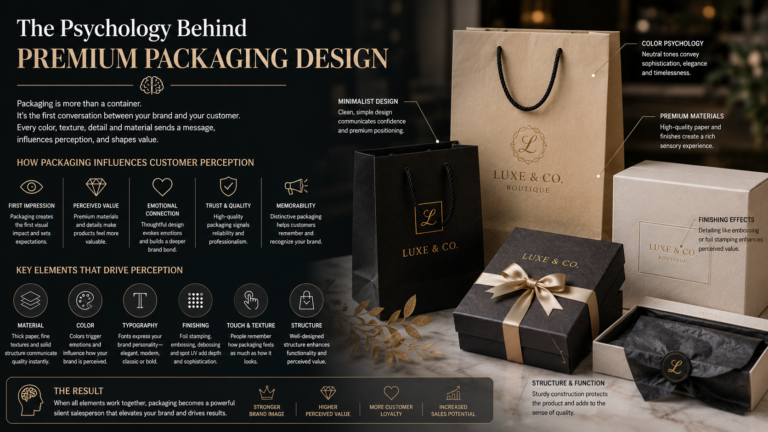

Why does one package feel expensive while another feels ordinary?
Two products can have similar quality, similar prices, and even similar features. Yet customers may perceive one as more valuable simply because of the way it is presented.
This is where the psychology of premium packaging design comes into play.
Packaging communicates with customers before they interact with the product itself. Through color, material, shape, texture, typography, and finishing, packaging can influence expectations about quality, price, trust, and brand positioning.
For retail brands, fashion companies, jewelry businesses, cosmetic brands, cafés, and other consumer-facing businesses, understanding these psychological signals can help turn ordinary packaging into a stronger brand experience.
The goal isn’t to make packaging unnecessarily expensive.
It is to make every design choice communicate the right message.
1. Packaging Creates the First Impression
Customers often encounter packaging before they fully experience the product.
In a physical store, the sequence may be:
Store → Product Display → Packaging → Purchase → Product Experience
For e-commerce, it may be:
Website → Delivery Box → Packaging → Product → Brand Experience
This means packaging becomes an important part of the first impression.
A poorly designed package can create uncertainty.
A carefully designed package can immediately communicate:
- Quality
- Professionalism
- Reliability
- Exclusivity
- Sustainability
- Creativity
This first impression is particularly important for premium and luxury products, where customers expect every part of the experience to feel intentional.
2. People Use Visual Signals to Judge Quality
Customers cannot immediately measure the quality of a product simply by looking at it.
Instead, they rely on signals.
Packaging is one of those signals.
A thick, well-constructed paper bag with carefully printed branding may suggest greater quality than a thin generic bag.
A rigid gift box may create expectations of a premium product inside.
A carefully selected material may suggest attention to detail.
This creates an important psychological relationship:
Packaging Quality → Expected Product Quality
Of course, attractive packaging cannot permanently compensate for a poor product.
But when the product itself delivers strong quality, premium packaging can reinforce the customer’s expectations.
3. Material Creates a Tactile Perception of Value
One of the most powerful characteristics of packaging is that customers can physically touch it.
This is especially important for shopping bags.
Customers may notice:
- Paper thickness
- Surface texture
- Smoothness
- Rigidity
- Handle material
- Weight
- Structure
These physical characteristics contribute to the overall perception of quality.
For example, a sturdy custom paper bag with a strong rope handle can feel substantially different from a lightweight generic bag.
This is why material selection is also a psychological design decision.
4. Thickness Can Signal Durability and Quality
Paper GSM is usually discussed as a technical specification.
From the customer’s perspective, however, it can influence perception.
A thicker paper bag may feel:
- More substantial
- More durable
- More premium
- More carefully produced
This does not mean thicker is always better.
Excessively thick paper can increase:
- Material consumption
- Cost
- Shipping weight
- Storage requirements
The goal is to choose a specification appropriate to the product and brand positioning.
For example, a jewelry retailer may require a very different bag specification from a supermarket.
Premium design is about the right level of quality, not simply the maximum amount of material.
5. Color Influences Brand Perception
Color is one of the fastest signals customers process.
Different color combinations can communicate different emotions and positioning.
Black
Often associated with:
- Sophistication
- Luxury
- Confidence
- Exclusivity
White
Can communicate:
- Simplicity
- Cleanliness
- Modernity
- Minimalism
Kraft Brown
Often associated with:
- Natural materials
- Sustainability
- Craftsmanship
- Simplicity
Deep Burgundy
Can communicate:
- Luxury
- Elegance
- Warmth
- Premium positioning
Metallic Gold
Often signals:
- Premium quality
- Celebration
- Luxury
- Special occasions
The important point is consistency.
A color becomes more powerful when it is repeatedly associated with the same brand across packaging, stores, websites, and marketing materials.
6. Minimalism Can Make Packaging Feel More Premium
Premium packaging does not necessarily need more information.
Often, it needs less.
A bag covered with multiple messages, graphics, patterns, and promotional elements can feel visually crowded.
A minimalist design might use:
One logo + one color + high-quality paper + plenty of empty space
This creates a sense of confidence.
The brand doesn’t need to explain everything.
The design itself communicates restraint.
This is particularly useful for:
- Luxury fashion
- Jewelry
- Cosmetics
- Premium lifestyle products
- High-end gifts
Minimalism also gives the logo more visual importance.
7. Empty Space Is a Design Tool
Empty space, sometimes called negative space, is not wasted space.
It helps customers focus on the most important visual elements.
Imagine a paper bag with:
- Large logo
- Multiple patterns
- Several slogans
- Product information
- Website
- QR code
- Social media icons
Everything is competing for attention.
Now imagine:
Clean background + centered logo + subtle finishing
The visual hierarchy becomes much clearer.
For premium brands, this simplicity can communicate confidence.
The design says, in effect:
We don’t need to fill every inch to make an impression.
8. Typography Communicates Personality
Fonts also influence how customers interpret a brand.
For example:
Serif Fonts
Can communicate:
- Tradition
- Elegance
- Heritage
- Luxury
Sans Serif Fonts
Can communicate:
- Modernity
- Simplicity
- Technology
- Clean design
Handwritten or Script Fonts
Can communicate:
- Creativity
- Personalization
- Craftsmanship
- Boutique positioning
The typography used on a custom paper bag should match the brand’s existing visual identity.
Changing the font without considering the wider brand system can create inconsistency.
9. Texture Adds Another Layer of Experience
Customers don’t only see packaging.
They touch it.
This makes texture especially valuable.
Different papers can create different tactile impressions:
- Smooth
- Rough
- Natural
- Soft-touch
- Textured
- Coated
A textured paper bag can create a handcrafted impression.
A smooth coated surface may feel more contemporary.
A natural kraft texture can reinforce an eco-conscious identity.
Texture therefore becomes another communication channel.
10. Finishing Creates a Sense of Craftsmanship
Special finishing can attract attention and create a stronger tactile experience.
Common techniques include:
Foil Stamping
Metallic foil can highlight logos and important elements.
Gold, silver, copper, and other finishes can create different visual effects.
Embossing
Raises the logo or pattern from the surface.
Customers can both see and feel the design.
Debossing
Creates a recessed design.
This can produce a subtle, understated effect.
Matte Finishing
Creates a soft, refined appearance.
Gloss Finishing
Creates stronger reflections and brighter visual effects.
The psychological value comes from the perception of detail.
Customers may not know the technical name of the finishing technique.
They simply notice that the packaging feels different.
11. Weight Can Influence Perceived Value
Physical weight can also affect perception.
A lightweight package may feel practical.
A more substantial package can sometimes feel more premium.
This principle is particularly relevant for:
- Luxury products
- Jewelry
- Gift packaging
- Premium cosmetics
- High-end fashion
However, weight should never be increased simply for psychological effect.
The better approach is to optimize the combination of:
Material + Structure + Durability + Weight
A package should feel appropriate to the product.
12. Structure Communicates Importance
The shape and construction of packaging can influence how customers interpret the product.
A simple flat bag may communicate practicality.
A rigid box may communicate value and protection.
A structured paper bag may communicate quality and reliability.
For example, a luxury jewelry purchase may use:
Rigid Gift Box + Tissue + Premium Paper Bag
The multiple layers create a sense of occasion.
The customer isn’t simply receiving a product.
They are experiencing a carefully designed presentation.
13. Consistency Builds Trust
Customers often associate consistency with professionalism.
If a brand uses:
- One logo style
- Consistent colors
- Consistent typography
- Matching packaging
- Consistent store design
customers receive repeated visual signals.
Over time, those signals become recognizable.
This is particularly important for growing retail chains.
A customer visiting one location should ideally experience the same brand identity at another location.
Custom packaging can help maintain that consistency.
14. Familiar Packaging Can Strengthen Brand Recognition
Brand recognition is built through repetition.
Customers may see a logo once and forget it.
They may see the same logo repeatedly across:
- Shopping bags
- Gift boxes
- Storefronts
- Websites
- Social media
- Advertising
and gradually develop stronger recognition.
This is why packaging should not be redesigned randomly.
A strong packaging system should preserve important brand elements while allowing controlled seasonal or campaign variations.
15. Packaging Can Trigger Emotional Responses
Purchasing is not always a purely rational decision.
Emotion plays a major role.
Packaging can contribute to feelings such as:
- Excitement
- Anticipation
- Celebration
- Trust
- Pride
- Nostalgia
- Exclusivity
This is particularly relevant for gifting.
A beautifully presented gift can create anticipation before the recipient even sees the product.
For seasonal campaigns, colors, patterns, and messages can further reinforce those emotions.
16. Premium Packaging Can Create a Sense of Exclusivity
People often place greater value on products that feel limited or special.
Packaging can support this perception through:
- Limited-edition artwork
- Seasonal colors
- Special finishing
- Numbered packaging
- Exclusive messages
- Special materials
For example:
Limited Edition Holiday Collection
printed on a premium custom bag can make the packaging feel like part of the collection.
The effect is particularly useful for fashion, cosmetics, jewelry, and lifestyle brands.
17. Packaging Can Influence Gift Expectations
Gift packaging has a unique psychological role.
The recipient may not know what’s inside.
Packaging becomes part of the anticipation.
A carefully designed bag or box can signal:
This is something special.
That is why gift packaging often uses:
- Premium paper
- Decorative handles
- Ribbons
- Tissue paper
- Foil
- Embossing
- Seasonal artwork
The package creates a visual and tactile prelude to the product.
18. Reusable Packaging Can Increase Long-Term Brand Exposure
A reusable bag can create a different psychological and marketing effect.
Instead of being discarded after one use, it becomes part of the customer’s everyday life.
For example:
Custom Canvas Tote
may later be used for:
- Shopping
- Work
- Travel
- Gym
- Daily errands
Every additional use creates another brand impression.
This makes reusable packaging particularly interesting for brands that want to combine:
Customer Utility + Brand Visibility + Sustainability
19. Sustainability Can Become Part of Brand Perception
Packaging material can influence how customers interpret a brand’s values.
Kraft paper, recycled paper, reusable canvas, and other material choices may support a sustainability-oriented brand identity.
But the message must be credible.
Brands should avoid making broad environmental claims that cannot be supported.
Instead, packaging can communicate specific facts where appropriate, such as:
- Recycled content
- Reusability
- Material information
- Relevant certifications
Sustainable packaging works best when the material choice matches the company’s broader environmental practices.
20. Packaging Can Communicate Price Positioning
Customers often use packaging as a clue about where a brand sits in the market.
A premium package can help communicate a premium positioning.
A simple kraft bag can communicate accessible, natural, or practical positioning.
A colorful printed bag may communicate youthfulness or creativity.
The packaging should therefore match the product’s price and positioning.
Imagine three products:
Budget Retail
Simple, functional packaging.
Mid-Market Brand
Branded paper bag with attractive printing and reliable construction.
Luxury Brand
Premium paper, refined design, custom handles, and carefully selected finishing.
None of these approaches is automatically better.
They are designed for different customer expectations.
21. Packaging Can Reduce Perceived Risk
Trust is especially important when customers are spending significant amounts of money.
Professional packaging can communicate that a business is established and organized.
This can be particularly valuable for:
- Jewelry
- Luxury goods
- Cosmetics
- Premium gifts
- Specialty products
Packaging does not replace trust signals such as product quality, customer service, or reviews.
But it can reinforce them.
A professional package tells customers that the company paid attention to details.
22. The Unboxing Experience Creates a Psychological Journey
A good packaging system can control the order in which customers discover information.
For example:
Outer Bag
Creates recognition.
↓
Gift Box
Builds anticipation.
↓
Tissue Paper
Adds another layer.
↓
Product
Creates the reveal.
↓
Thank-You Card
Provides a personal closing message.
This sequence creates a small psychological journey.
For e-commerce brands, this can be particularly powerful because packaging is often the first physical interaction customers have with the brand.
23. Packaging Can Make Customers Feel Part of a Brand Community
Strong brands often create a sense of belonging.
Packaging can support that feeling through:
- Brand language
- Community messages
- Special editions
- Membership information
- Loyalty program QR codes
- Social media invitations
For example:
“Join Our Community”
or
“Discover More”
can turn a physical package into the beginning of another interaction.
This is where packaging moves beyond appearance and becomes part of the customer relationship.
24. The Psychology of Touch Matters in Retail
Physical stores provide one major advantage over digital shopping:
Customers can touch products.
Packaging can take advantage of the same principle.
A shopper may pick up a bag and immediately notice:
- Paper thickness
- Handle texture
- Surface finish
- Weight
- Structure
This creates a sensory experience that digital advertising cannot fully reproduce.
For physical retail brands, tactile packaging can therefore be an important differentiator.
25. Don’t Confuse Expensive With Premium
One of the most important lessons in premium packaging design is that more expensive does not always mean more effective.
Adding:
- More colors
- More finishing
- More materials
- More layers
- More decorations
doesn’t automatically improve the customer experience.
Premium packaging is often about making the right choices.
For example:
High-quality paper + minimalist logo + excellent printing + strong handle
may be more effective than:
Multiple finishes + complicated graphics + excessive decoration
The psychological effect comes from coherence.
Every element should support the same brand message.
26. How B2B Buyers Can Apply Packaging Psychology
When selecting custom packaging, procurement teams should ask more than:
“What’s the unit price?”
Consider:
What should customers feel?
- Premium?
- Natural?
- Modern?
- Elegant?
- Fun?
- Sustainable?
What should customers notice first?
- Logo?
- Product?
- Pattern?
- Brand color?
What should they remember?
- Brand name?
- Visual identity?
- Packaging experience?
What should they do next?
- Visit the website?
- Scan a QR code?
- Reuse the bag?
- Follow the brand?
- Return to the store?
These questions turn packaging from a simple purchasing decision into a strategic branding decision.
27. A Practical Premium Packaging Framework
Brands can evaluate their packaging using five layers.
Layer 1: Visual
Consider:
- Color
- Logo
- Typography
- Graphics
Layer 2: Tactile
Consider:
- Paper
- Texture
- Thickness
- Handle
Layer 3: Functional
Consider:
- Size
- Strength
- Carrying comfort
- Product protection
Layer 4: Emotional
Consider:
- Exclusivity
- Celebration
- Trust
- Sustainability
- Brand personality
Layer 5: Marketing
Consider:
- Website
- QR code
- Social media
- Loyalty programs
- Campaign messaging
When these five layers work together, packaging becomes much more than a container.
28. Premium Packaging Design Checklist
Before ordering custom packaging, brands should review:
-
Does the packaging match our brand identity?
-
Is the material appropriate for our product?
-
Does the paper feel substantial enough?
-
Is the bag easy and comfortable to carry?
-
Is the logo clearly visible?
-
Are the colors consistent with our brand?
-
Is the typography appropriate?
-
Is there enough visual space?
-
Does the finishing support the design?
-
Does the packaging communicate the right price positioning?
-
Is sustainability part of the brand strategy?
-
Could customers reuse the packaging?
-
Would the packaging look good in photographs?
-
Can it support seasonal campaigns?
-
Has a physical sample been tested?
Conclusion
The psychology behind premium packaging design is ultimately about perception.
Customers use visual and physical signals to form expectations about a brand and its products. Material, color, typography, texture, structure, finishing, and even the weight of a package can influence those perceptions.
For retail brands, this creates an important opportunity.
A custom paper bag is not simply something that carries a purchase.
It can communicate:
Who you are.
What your brand values.
How you want customers to feel.
And how you want them to remember you.
The most effective premium packaging is not necessarily the most expensive.
It is the packaging where every detail has a purpose.
When design, materials, functionality, and branding work together, an ordinary bag can become a powerful part of the customer experience.
And sometimes, the first thing a customer remembers about a product is not the product itself.
It is the feeling they had when they held the package.