
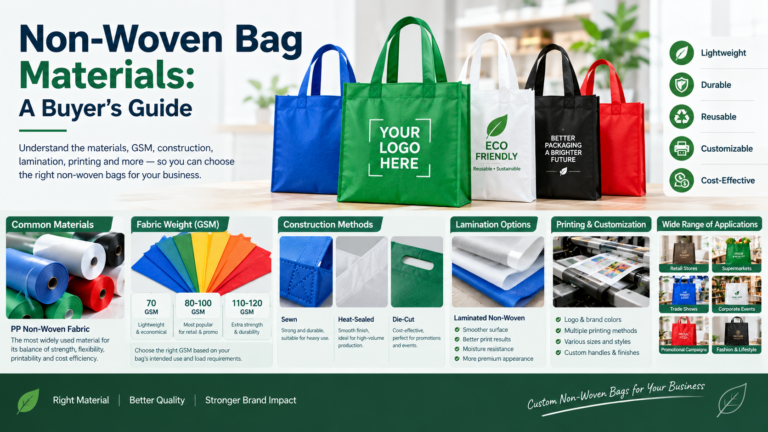

When businesses purchase custom non-woven bags, the material is one of the most important factors to consider. It affects the bag’s strength, appearance, printing quality, durability, cost, and suitability for different applications.
However, “non-woven bag” is a broad product category. Bags that look similar can perform very differently depending on the material, fabric weight, construction method, lamination, and handle design.
For B2B buyers, understanding these differences can help avoid common purchasing mistakes and make it easier to choose the right specification for a project.
This guide explains the key non-woven bag materials buyers should know before placing an order.
What Is Non-Woven Bag Material?
Unlike woven fabric, which is produced by interlacing individual threads, non-woven fabric is manufactured by bonding fibers together through mechanical, thermal, or chemical processes.
For shopping bags and promotional packaging, polypropylene (PP) is one of the most commonly used materials.
PP non-woven fabric offers several advantages for commercial packaging:
- Lightweight construction
- Good flexibility
- Suitable strength for everyday carrying
- Easy customization
- Good printing compatibility
- Reusable characteristics
- Competitive production cost
- Available in different fabric weights
This makes PP non-woven bags popular among retailers, supermarkets, promotional companies, fashion brands, trade shows, and corporate events.
PP Non-Woven Fabric: The Most Common Choice
Polypropylene is a thermoplastic polymer widely used in packaging and industrial products.
When PP is processed into non-woven fabric, it creates a lightweight sheet-like material that can be cut, printed, sealed, sewn, and formed into bags.
For B2B packaging applications, PP non-woven fabric is popular because it provides a practical balance between cost, durability, customization, and appearance.
The exact performance of a finished bag depends not only on the fact that it uses PP, but also on the fabric weight and bag construction.
That is why buyers should not evaluate a supplier’s quotation based only on the phrase “PP non-woven bag.”
What Does GSM Mean for Non-Woven Bags?
One of the most important material specifications is GSM, which means grams per square meter.
GSM indicates the weight of the fabric per square meter. In general, a higher GSM means a heavier and more substantial fabric.
Common non-woven bag materials may fall into different GSM ranges depending on the intended application. For many commercial bags, approximately 70–120 GSM is a commonly discussed range.
For example:
Lower GSM
Lower-GSM material is generally:
- Lighter
- More economical
- Easier to transport in large quantities
- Suitable for lightweight promotional applications
It can work well for campaigns, events, giveaways, and bags carrying relatively light products.
Medium GSM
Medium-weight non-woven fabric provides a balance between cost and durability.
It is often suitable for:
- Retail shopping bags
- Supermarket bags
- Promotional bags
- Event packaging
- Corporate giveaways
Higher GSM
Higher-GSM fabric generally provides a thicker and more substantial feel.
It may be preferred when the bag needs:
- Higher perceived quality
- Better carrying strength
- A more premium appearance
- Greater durability
- Support for heavier products
However, higher GSM does not automatically mean that a finished bag will be stronger in every situation. Bag dimensions, handles, seams, bottom construction, printing, and manufacturing quality also matter.
Why GSM Should Not Be the Only Material Specification
A common purchasing mistake is assuming that GSM alone determines bag quality.
In reality, buyers should evaluate the complete bag structure.
For example, a bag made from relatively heavy fabric may still have performance issues if the handle attachment is weak or the bottom construction is not suitable for the intended load.
A proper B2B specification should consider:
Material + GSM + bag size + construction + handle + printing + intended load
This gives a much more accurate picture of the final product.
Laminated Non-Woven Material
Another important material option is laminated PP non-woven fabric.
A laminated layer can be added to the surface of non-woven fabric to create a different appearance and improve certain functional characteristics.
Laminated non-woven bags are often chosen when buyers want:
- A smoother surface
- More vibrant visual presentation
- Additional surface protection
- A more structured appearance
- High-quality promotional printing
The lamination can also influence how colors and graphics appear on the finished bag.
For brands that place a strong emphasis on visual presentation, laminated non-woven bags can be an attractive alternative to standard non-laminated fabric.
Non-Woven Bag Material and Printing
Material selection also affects printing performance.
PP non-woven bags can be customized with brand logos, graphics, text, colors, and promotional designs.
Before production, buyers should consider:
- Number of printing colors
- Artwork complexity
- Logo size
- Printing position
- Required color consistency
- Surface appearance
- Printing method recommended by the manufacturer
A simple one-color logo and a detailed full-color design may require different production approaches.
For large B2B orders, buyers should always approve artwork and, when necessary, a physical sample before mass production.
Does Thicker Material Always Mean Better Quality?
Not necessarily.
A thicker bag can provide a more substantial feel, but “better” depends on the purpose of the packaging.
Imagine two different projects.
A company distributing thousands of lightweight promotional items at a trade show may prioritize low weight and cost.
A fashion retailer carrying boxed products may prioritize a thicker, more durable material with reinforced handles.
Both bags can be high-quality products because they are designed for different requirements.
The correct question is not:
“What is the thickest material available?”
Instead, buyers should ask:
“What material specification is appropriate for the product the bag needs to carry?”
Material Selection Based on Application
Different industries may require different non-woven bag specifications.
Retail Shopping Bags
Retail bags often need a combination of:
- Good appearance
- Reliable strength
- Comfortable handles
- Brand printing
- Reasonable unit cost
Medium-weight PP non-woven material can be a practical choice for many retail applications.
Supermarket Bags
Supermarket applications may require stronger construction because customers can place multiple products inside one bag.
Buyers should pay attention to:
- Fabric weight
- Bag dimensions
- Handle length
- Handle attachment
- Bottom construction
- Expected load
Load testing can be especially useful when the bags are designed for repeated use.
Promotional Bags
Promotional bags are often distributed in large quantities, so cost and production efficiency can be major considerations.
Lower or medium GSM material may be appropriate depending on the promotional items being carried.
Printing quality is also important because the bag itself becomes a mobile marketing tool.
Trade Show Bags
Trade show bags are usually designed to carry brochures, catalogs, samples, promotional products, and other event materials.
For these projects, buyers often prioritize:
- Large printable areas
- Brand visibility
- Lightweight transportation
- Comfortable handles
- Efficient bulk production
Fashion and Retail Brands
Fashion brands may place more emphasis on appearance and perceived quality.
They may choose:
- Higher-GSM fabric
- Laminated non-woven material
- Special colors
- Premium printing
- Reinforced handles
- Customized dimensions
The material should support the brand’s overall packaging strategy rather than simply minimize unit price.
Sewn, Heat-Sealed, and Die-Cut Construction
Material is only one part of the equation.
The way the non-woven fabric is converted into a bag also influences performance.
Sewn Non-Woven Bags
Sewn bags use stitching to connect the fabric panels and handles.
They can provide a strong and durable structure and are suitable for applications where the bag needs to withstand repeated carrying.
Heat-Sealed Non-Woven Bags
Heat sealing uses controlled heat to bond sections of the PP material.
This construction can support efficient automated production and is commonly used for certain high-volume bag styles.
Die-Cut Non-Woven Bags
Die-cut bags are produced by cutting the fabric into a specific shape, sometimes including integrated handles.
They are often used for promotional campaigns and lightweight applications.
The appropriate construction depends on the bag design, expected load, production volume, and desired appearance.
Handle Material and Construction Matter Too
When evaluating non-woven bag materials, buyers sometimes focus heavily on the fabric and overlook the handles.
This can be a mistake.
The handle is one of the areas that experiences significant stress during use.
Important considerations include:
- Handle material
- Handle width
- Handle length
- Attachment method
- Reinforcement
- Stitching or sealing quality
- Expected carrying load
A strong fabric cannot compensate for an improperly designed handle.
For bags intended to carry heavier products, the manufacturer should evaluate the entire load-bearing structure rather than simply increasing fabric GSM.
How Material Affects Cost
Material is directly related to the final unit cost.
Several factors can influence the price of a custom non-woven bag:
- Fabric GSM
- Bag dimensions
- Material consumption
- Laminated or non-laminated construction
- Printing requirements
- Handle type
- Sewing or heat-sealing process
- Additional reinforcement
- Order quantity
- Packaging requirements
Higher material consumption generally increases the manufacturing cost.
However, reducing GSM simply to achieve the lowest possible quotation may create problems if the bag does not perform as expected.
For B2B buyers, the goal should be appropriate material efficiency, not simply the lowest material cost.
What Should Buyers Ask a Non-Woven Bag Supplier?
Before placing a bulk order, buyers should ask the supplier to provide clear material information.
Useful questions include:
- What material is the bag made from?
- Is it PP non-woven fabric?
- What is the fabric GSM?
- Is the material laminated?
- What construction method is used?
- What handle material is recommended?
- What load is the bag designed to carry?
- Can the supplier provide a physical sample?
- Can the bag be load tested?
- How will material and printing quality be checked during production?
Clear answers can help buyers compare suppliers on a like-for-like basis.
What Is the Best Non-Woven Bag Material?
There is no single “best” material for every project.
The right material depends on:
- Product weight
- Bag size
- Intended usage
- Required durability
- Brand positioning
- Printing requirements
- Target cost
- Order quantity
- Expected reuse
For a promotional giveaway, a lightweight PP non-woven bag may be the most efficient solution.
For a retail application requiring repeated use, a medium or higher-GSM material with stronger construction may be more appropriate.
For premium visual presentation, laminated non-woven fabric may be worth considering.
The best material is therefore the one that provides the right balance between performance, appearance, cost, and application requirements.
Non-Woven Bag Material Buyer Checklist
Before requesting a quotation, B2B buyers can prepare the following information:
Material
- PP non-woven
- Laminated or non-laminated
Fabric Weight
- Required GSM or recommended GSM
Size
- Width
- Height
- Gusset, if required
Construction
- Sewn
- Heat-sealed
- Die-cut
Handles
- Length
- Width
- Material
- Reinforcement requirements
Printing
- Logo
- Artwork
- Number of colors
- Printing area
Performance
- Expected carrying weight
- Reusability requirements
- Load testing requirements
Order
- Quantity
- Packaging requirements
- Delivery destination
- Target delivery schedule
Providing these specifications makes it easier for a manufacturer to recommend the right material and prepare an accurate quotation.
Why Material Quality Control Matters
For large B2B orders, consistency is just as important as the original material selection.
A buyer may approve a sample with the correct GSM, color, printing, and construction. The mass-production order should then maintain the agreed specifications.
Quality control can include:
- Fabric GSM inspection
- Material appearance inspection
- Color checking
- Dimension measurement
- Printing inspection
- Handle inspection
- Seam or sealing inspection
- Load testing
- Finished-bag inspection
- Quantity verification
- Packing inspection
A reliable manufacturing process should control quality throughout production rather than checking only a few finished bags at the end.
How to Choose the Right Non-Woven Bag Material
When selecting materials, B2B buyers can follow a simple process.
Step 1: Define the Application
Determine what the bag will be used for.
Is it retail packaging, promotional distribution, supermarket shopping, event merchandise, or branded product packaging?
Step 2: Estimate the Load
Identify approximately how much weight the bag needs to carry.
This helps determine an appropriate combination of GSM, dimensions, handle design, and construction.
Step 3: Choose the Appearance
Consider whether the project requires standard non-woven fabric or a laminated surface.
Think about the brand’s colors, logo, printing requirements, and desired visual quality.
Step 4: Balance Cost and Performance
Do not select material based solely on the lowest quotation.
Instead, compare the expected service life and performance against the target cost.
Step 5: Request a Sample
A physical sample allows buyers to evaluate:
- Fabric feel
- Thickness
- Color
- Printing
- Handles
- Dimensions
- Construction
- Overall appearance
Step 6: Confirm Production Specifications
Once the sample is approved, all key specifications should be clearly documented before mass production begins.
This is especially important for repeat orders because consistent specifications help maintain the same product quality across different production batches.
Final Thoughts
Understanding non-woven bag materials is essential for businesses purchasing custom bags in bulk.
For most commercial applications, PP non-woven fabric provides a practical combination of flexibility, durability, printability, customization, and cost efficiency. However, the right choice depends on more than the material name.
GSM, lamination, construction method, handle design, printing, bag dimensions, and intended load all contribute to the performance of the finished product.
For B2B buyers, the best approach is to define the application first, establish the required performance, compare material specifications, approve a sample, and then confirm all production details with the manufacturer.
A well-specified non-woven bag does more than carry products. It can become a durable, reusable part of a company’s packaging and branding strategy.