
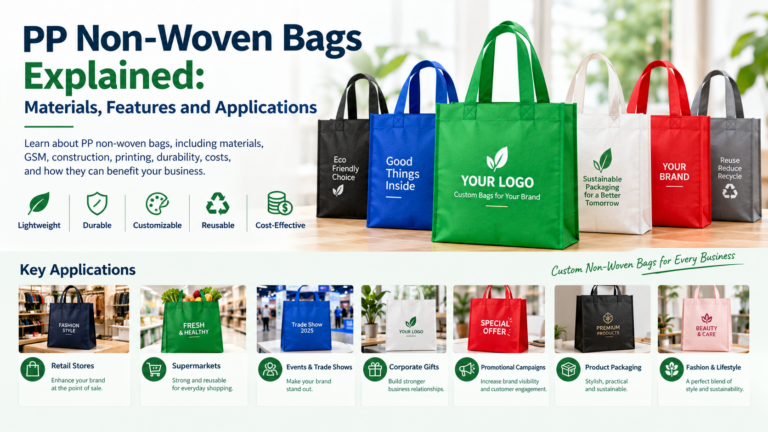

PP non-woven bags have become a widely used packaging and promotional solution for retailers, supermarkets, events, brands, and organizations around the world.
Lightweight, customizable, and available in a wide range of colors and constructions, these bags can be designed for everything from promotional giveaways to reusable retail shopping.
But what exactly are PP non-woven bags? What does GSM mean? How strong are they? And which type is right for your business?
For B2B buyers, understanding the material and construction of a non-woven bag is essential before placing a custom order.
This guide explains the materials, key features, manufacturing options, and applications of PP non-woven bags.
What Are PP Non-Woven Bags?
PP non-woven bags are bags manufactured from polypropylene (PP) non-woven fabric.
Polypropylene is a synthetic polymer widely used in packaging and many other commercial applications. In non-woven fabric production, polypropylene fibers are processed and bonded together to create a sheet-like material.
Unlike traditional woven fabrics, non-woven materials are not made by weaving individual yarns together.
The result is a lightweight fabric that can be cut, printed, folded, heat-sealed, sewn, and customized into different bag designs.
For businesses, this makes PP non-woven fabric a flexible material for branded packaging.
What Does “Non-Woven” Mean?
The term “non-woven” describes how the fabric is manufactured.
Traditional woven fabric is created by interlacing yarns in a specific pattern.
Non-woven fabric is produced by bonding fibers together through processes such as mechanical entanglement, thermal bonding, or other manufacturing techniques.
This creates a material with its own combination of:
- Weight
- Thickness
- Flexibility
- Strength
- Surface texture
- Appearance
For commercial bags, the manufacturing process can be adjusted to produce different fabric specifications for different applications.
Why Is Polypropylene Used for Non-Woven Bags?
PP is particularly useful for commercial non-woven bags because it combines several properties that are valuable for packaging.
Depending on the specific material and construction, PP non-woven fabric can offer:
- Lightweight construction
- Good flexibility
- Useful durability
- Easy customization
- Multiple color options
- Large printable surfaces
- Efficient large-volume production
For B2B buyers, another major advantage is the flexibility of customization.
A manufacturer can produce bags in different sizes, colors, GSM levels, handle styles, printing designs, and construction methods.
PP Non-Woven Bag GSM Explained
One of the most important specifications when purchasing non-woven bags is GSM.
GSM means grams per square meter.
It describes the weight of the fabric and is commonly used to distinguish lighter and heavier non-woven materials.
Commercial non-woven bags can be produced in a range of GSM specifications, such as:
- 70 GSM
- 80 GSM
- 90 GSM
- 100 GSM
- 110 GSM
- 120 GSM
A higher GSM generally means a heavier fabric, but GSM alone does not determine the overall strength of a finished bag.
Bag size, handle construction, seams, reinforcement, bottom design, and manufacturing method also affect performance.
Lower GSM
Lower-weight fabric may be suitable for:
- Promotional events
- Trade shows
- Conferences
- Giveaways
- Lightweight products
The main advantages are often lower material consumption and lightweight transportation.
Medium GSM
Medium-weight materials can provide a practical balance between cost and durability.
They can be suitable for:
- Retail shopping
- Supermarkets
- Promotional campaigns
- Corporate events
- Reusable packaging
Higher GSM
Higher-weight fabric can provide a more substantial feel and may be appropriate for applications requiring additional durability.
Examples include:
- Heavy retail products
- Grocery shopping
- Long-term reusable applications
- Premium promotional bags
- Larger shopping bags
The correct GSM should always be selected according to the actual application rather than assuming that the highest GSM is automatically the best choice.
What Are the Main Features of PP Non-Woven Bags?
PP non-woven bags offer several features that make them attractive to businesses.
1. Lightweight
Non-woven fabric is relatively lightweight, which can be useful for both customers and logistics.
When thousands of bags are shipped internationally, the weight of the packaging itself can become an important consideration.
2. Customizable
Businesses can customize:
- Size
- Color
- Logo
- Artwork
- Handles
- GSM
- Construction
- Lamination
- Finishing
This makes PP non-woven bags suitable for different brand identities and applications.
3. Reusable
Many non-woven bags are designed for repeated use.
This can give businesses an opportunity to keep their branding visible after the original purchase or event.
4. Printable
The relatively large surface area provides space for logos, graphics, promotional messages, and other branding elements.
5. Flexible Construction
Depending on the design, bags can be manufactured using different production methods, including sewn, heat-sealed, and die-cut constructions.
Sewn vs. Heat-Sealed vs. Die-Cut Non-Woven Bags
Construction method is an important consideration when choosing a PP non-woven bag.
Sewn Non-Woven Bags
Sewn bags use stitching to connect different fabric components.
They can provide strong construction and are suitable for applications where durability and reusable performance are important.
Sewn bags can also accommodate a variety of handle designs.
Typical applications include:
- Retail shopping
- Supermarkets
- Promotional packaging
- Corporate gifts
- Reusable shopping
Heat-Sealed Non-Woven Bags
Heat-sealed bags use thermal bonding to connect sections of the fabric.
This construction can be suitable for certain bag designs and efficient high-volume production.
They can be a practical choice when the buyer wants a simple structure with efficient manufacturing.
Die-Cut Non-Woven Bags
Die-cut bags can be cut from a single piece of non-woven material, with the handles integrated into the bag structure.
They are commonly used for:
- Promotional campaigns
- Events
- Conferences
- Short-term marketing activities
- High-volume giveaways
The construction method should be selected according to the required durability, appearance, quantity, and budget.
Non-Woven Bag Handle Options
The handle is an important part of both the appearance and functionality of a custom bag.
Common handle designs include:
- Self-material handles
- Cut-out handles
- Loop handles
- Webbing handles
- Reinforced handles
- Sewn handles
For heavier products, handle attachment and reinforcement are particularly important.
A strong non-woven fabric does not necessarily mean the complete bag can carry heavy products.
The connection between the handle and body needs to be designed according to the expected load.
For promotional bags, a simple integrated handle may be sufficient.
For retail shopping bags, reinforced sewn handles may provide a more suitable solution.
Laminated PP Non-Woven Bags
Some PP non-woven bags use lamination to add an additional surface layer.
Lamination can change the appearance and surface characteristics of the bag.
Potential advantages include:
- Smoother surface
- More polished appearance
- Additional moisture resistance
- Enhanced printing presentation
- Easier surface cleaning
Laminated bags are often considered when a project requires stronger visual impact or additional surface protection.
However, lamination also changes the material characteristics and production cost.
For buyers, it should be treated as a design and performance decision rather than an automatic requirement.
Printing Options for PP Non-Woven Bags
Branding is one of the main reasons companies choose custom non-woven bags.
A bag can be printed with:
- Company logos
- Brand colors
- Slogans
- Product graphics
- Website information
- Event details
- Promotional messages
- Social media information
Depending on the material, artwork, quantity, and production requirements, manufacturers can recommend suitable printing processes.
Before production, buyers should confirm:
- Artwork dimensions
- Printing area
- Number of colors
- Logo position
- Color references
- Front and back artwork
- Required print quality
For large B2B orders, a physical sample can help confirm how the final artwork will look on the actual material.
How Strong Are PP Non-Woven Bags?
The strength of a non-woven bag depends on the complete design rather than one specification.
Important factors include:
Fabric GSM
Heavier fabric can provide a more substantial structure.
Bag Size
Larger bags may experience greater stress when filled with products.
Handle Design
Handle material and attachment affect carrying capacity.
Reinforcement
Additional reinforcement can improve performance in high-stress areas.
Bottom Construction
The bottom needs to support the contents and distribute weight effectively.
Manufacturing Method
Sewn and heat-sealed constructions have different structural characteristics.
For B2B buyers, it is therefore better to tell the manufacturer what the bag needs to carry rather than simply requesting a specific GSM.
Can PP Non-Woven Bags Be Reused?
Many PP non-woven bags are designed with reusable applications in mind.
A customer may use the same branded bag for multiple shopping trips, storage, events, or other everyday purposes.
For brands, this creates an additional marketing opportunity.
Instead of disappearing immediately after a single transaction, the packaging can continue displaying the brand in different environments.
However, actual service life depends on the bag’s material, construction, loading conditions, frequency of use, and care.
Manufacturers should therefore avoid treating “reusable” as a universal guarantee of unlimited durability.
Common Applications of PP Non-Woven Bags
PP non-woven bags are used across many industries.
Retail Stores
Fashion retailers, gift stores, specialty shops, and other businesses can use custom bags to combine packaging with brand promotion.
The bag can carry the company’s logo and visual identity while customers leave the store.
Supermarkets and Grocery Stores
Larger or reinforced non-woven bags can be designed for grocery and shopping applications.
The required specifications should take expected product weight into account.
Trade Shows and Exhibitions
Non-woven bags are popular at exhibitions because they provide a practical way for visitors to carry brochures, catalogs, samples, and promotional products.
The large printable surface also provides valuable branding space.
Corporate Events
Businesses can use customized bags for conferences, seminars, employee events, and corporate campaigns.
Promotional Campaigns
A low-cost custom non-woven bag can serve as a practical promotional item while providing repeated brand exposure.
Product Packaging
Some businesses use non-woven bags as secondary packaging for products that benefit from reusable presentation.
PP Non-Woven Bags for Fashion Brands
Fashion brands often pay close attention to packaging appearance.
A custom non-woven bag can be designed with:
- Brand-specific colors
- Minimalist logos
- Premium handles
- Laminated surfaces
- Custom sizes
- Carefully selected printing
For lower-cost fashion packaging, non-woven bags can provide a practical alternative to more expensive textile bags.
For premium positioning, buyers may also compare PP non-woven fabric with canvas or cotton depending on the desired tactile experience.
PP Non-Woven Bags for Promotional Events
Promotional applications often have different requirements from retail packaging.
For an event, the priority may be:
- Large logo visibility
- Low unit cost
- Fast production
- Lightweight transportation
- Large order quantities
- Simple construction
A die-cut or lightweight non-woven bag may therefore be more appropriate than a heavy-duty sewn bag.
The right design depends on how long the bag is expected to remain in use and what products it needs to carry.
PP Non-Woven Bags vs. Canvas Bags
Businesses frequently compare non-woven bags with canvas bags.
Canvas generally provides a textile appearance and can offer a more premium or natural feel.
PP non-woven bags can provide advantages such as:
- Lower material cost
- Lightweight construction
- Flexible colors
- Efficient production
- Large-scale customization
- Strong promotional value
Canvas may be more suitable when tactile quality and premium textile positioning are priorities.
The right choice depends on the brand, application, budget, and expected product weight.
PP Non-Woven Bags vs. Paper Bags
Paper bags and PP non-woven bags serve different packaging needs.
Paper bags can provide:
- A paper-based appearance
- Strong visual branding
- Multiple paper options
- Premium finishing possibilities
- A popular solution for retail and takeaway packaging
PP non-woven bags can provide:
- Reusable construction
- Lightweight material
- Textile-like appearance
- Flexible colors
- Promotional versatility
For a fashion retailer, for example, a premium paper bag may be preferred for immediate presentation, while a reusable non-woven bag may be selected when repeated use is a key requirement.
How Much Do Custom PP Non-Woven Bags Cost?
There is no universal price for a custom PP non-woven bag.
The final cost can depend on:
- GSM
- Bag dimensions
- Fabric color
- Printing
- Printing colors
- Lamination
- Handle type
- Construction method
- Reinforcement
- Order quantity
- Packaging
- Shipping destination
A simple die-cut promotional bag and a large sewn shopping bag with reinforced handles will naturally have different production costs.
For accurate B2B quotations, buyers should provide detailed specifications instead of requesting a price based only on the phrase “custom non-woven bag.”
How Does MOQ Affect the Order?
MOQ means Minimum Order Quantity.
Different non-woven bag designs may have different MOQs depending on:
- Manufacturing process
- Printing method
- Material
- Bag size
- Customization
- Production setup
A lower MOQ can be useful for:
- New product launches
- Market testing
- Small campaigns
- Seasonal projects
Higher quantities may provide better unit economics for established brands with predictable demand.
The best order quantity is not necessarily the largest quantity possible.
Buyers should balance unit cost against inventory, storage, cash flow, and expected consumption.
What Should B2B Buyers Specify When Ordering?
A detailed specification can make supplier communication much easier.
A typical inquiry could include:
Material: PP Non-Woven
GSM: 90 GSM
Size: 400 × 350 × 100 mm
Color: Custom
Printing: Custom logo
Printing Area: Front and back
Handle: Reinforced loop handle
Lamination: Required / Not required
Construction: Sewn
Quantity: 10,000 pcs
Application: Retail shopping
Destination: Required delivery location
Delivery Date: Required deadline
The manufacturer can then recommend whether the selected material and construction are suitable.
What Quality Control Should Buyers Expect?
A professional non-woven bag manufacturer should have quality checks throughout production.
Important QC points may include:
Material Inspection
Check:
- Fabric GSM
- Color
- Surface quality
- Material consistency
Printing Inspection
Check:
- Logo position
- Color
- Sharpness
- Printing consistency
Dimension Inspection
Check:
- Width
- Height
- Gusset
- Handle length
Construction Inspection
Check:
- Stitching
- Heat sealing
- Folding
- Bottom structure
- Reinforcement
Handle Testing
Check:
- Attachment
- Strength
- Position
- Carrying performance
Final Inspection
Finished bags should be checked before packing and shipment.
For large B2B orders, these inspection procedures can help reduce the risk of receiving inconsistent products.
How to Choose the Right PP Non-Woven Bag
A useful way to select a bag is to start with the application rather than the material.
Ask these questions:
What will the bag carry?
Lightweight promotional materials require different specifications from groceries or heavy retail products.
How often will it be reused?
A short promotional campaign may require a different construction from a reusable retail shopping bag.
What appearance does the brand need?
Consider fabric color, printing, lamination, handles, and finishing.
What quantity is required?
The order quantity can affect both production cost and MOQ.
What is the target budget?
Material GSM, construction, printing, and finishing can all influence the quotation.
When is the packaging needed?
Production and shipping lead times should be considered before placing the order.
A Practical PP Non-Woven Bag Buyer Checklist
Before confirming an order, buyers can review:
Material
- PP non-woven material confirmed
- GSM confirmed
- Fabric color confirmed
- Material quality approved
Design
- Bag dimensions confirmed
- Logo artwork approved
- Printing area confirmed
- Handle design selected
Construction
- Sewn / heat-sealed / die-cut construction confirmed
- Bottom structure confirmed
- Reinforcement requirements confirmed
- Load requirements communicated
Finishing
- Lamination confirmed
- Surface finishing confirmed
- Sample approved
Production
- MOQ confirmed
- Production lead time confirmed
- Quality requirements confirmed
Delivery
- Packing method confirmed
- Carton information confirmed
- Shipping method confirmed
- Delivery deadline confirmed
Final Thoughts
PP non-woven bags are a flexible packaging solution for businesses that need customizable, lightweight, and reusable bags for retail, promotional, event, and commercial applications.
The most important specifications are not limited to the fabric itself.
GSM, bag dimensions, construction method, handles, reinforcement, printing, lamination, load requirements, order quantity, and quality control all contribute to the final product.
For B2B buyers, the best approach is to start with the intended application and then work backward to determine the right specifications.
A lightweight promotional campaign may need a simple die-cut bag.
A supermarket may require a stronger reusable shopping bag.
A fashion brand may prioritize customized colors, premium printing, and carefully selected handles.
There is no single “best” PP non-woven bag for every business.
The best bag is the one that matches your product, brand, budget, quantity, performance requirements, and customer experience.
When those requirements are clearly defined, a professional non-woven bag manufacturer can help turn them into a practical custom packaging solution.