
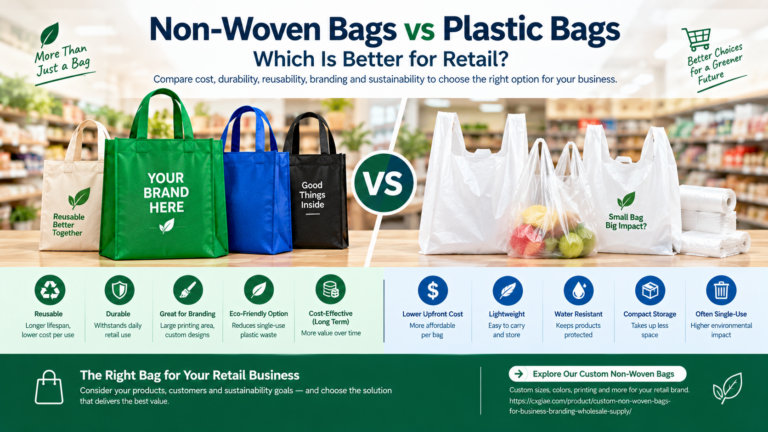

For retailers, choosing the right shopping bag is no longer simply a question of price.
Plastic bags remain attractive because they are lightweight, inexpensive, and convenient. However, growing restrictions on lightweight plastic carrier bags, increasing consumer awareness, and the demand for reusable packaging are changing how retailers approach shopping bags.
Non-woven bags have become one of the most widely used reusable alternatives. Made primarily from polypropylene (PP), they offer a balance of durability, customization, cost, and branding potential.
But are non-woven bags really better than plastic bags for retail?
The answer depends on how the bags are used, how many times customers reuse them, what products they need to carry, and what the retailer is trying to achieve.
This guide compares non-woven bags and plastic bags from a practical B2B retail perspective.
Non-Woven Bags vs Plastic Bags: At a Glance
| Factor | Non-Woven Bags | Plastic Bags |
|---|---|---|
| Reusability | High | Usually low for lightweight bags |
| Durability | Good to excellent depending on GSM and construction | Varies significantly |
| Purchase cost | Higher per bag | Usually lower per bag |
| Branding | Excellent | Good |
| Printing area | Large and highly customizable | Depends on bag type |
| Carrying heavier products | Generally better | Depends on plastic thickness |
| Storage | Can be folded and stored efficiently | Very compact |
| Customer perception | Reusable and promotional | Often associated with single use |
| Long-term brand exposure | High | Low to moderate |
| Regulatory pressure | Generally lower for reusable products | Higher for lightweight single-use bags |
| Best use | Reusable retail, promotions, events, shopping | Short-term or specific applications |
The important point is that these two products serve different purposes.
A lightweight plastic carrier bag is designed primarily for convenience and short-term use. A non-woven bag is designed to be used repeatedly.
That difference changes the economics and environmental impact of the bag.
What Are Non-Woven Bags?
Non-woven bags are commonly manufactured from polypropylene (PP) non-woven fabric.
Unlike woven fabric, where threads are interlaced, non-woven fabric is produced by bonding fibers together to create a sheet-like material.
For retail applications, non-woven bags can be manufactured in different GSM levels, sizes, constructions, colors, and handle styles.
Common options include:
- Standard PP non-woven shopping bags
- Laminated non-woven bags
- Gusseted shopping bags
- Foldable promotional bags
- Box-style structured bags
- Die-cut handle bags
- Loop-handle bags
- Reinforced heavy-duty bags
Printing can also be customized with a retailer’s logo, slogan, artwork, product information, or promotional graphics.
For businesses, this means the shopping bag can function as more than packaging. It can also become a mobile branding tool.
What Are Plastic Retail Bags?
Plastic retail bags are generally made from plastic films such as polyethylene.
Different plastic bags can have very different properties depending on their material, thickness, construction, and intended application.
Common retail examples include:
- Lightweight HDPE carrier bags
- LDPE shopping bags
- Reusable thicker plastic bags
- Die-cut plastic bags
- T-shirt bags
- Merchandise bags
- Produce bags
The biggest advantage of plastic bags is their low material usage and low unit cost, particularly for lightweight single-use applications.
They are also:
- Lightweight
- Water resistant
- Easy to transport
- Easy to store
- Fast to distribute
- Inexpensive for high-volume use
For retailers that need a disposable carrier bag at the lowest possible upfront cost, plastic remains difficult to beat.
But upfront price is only one part of the purchasing decision.
1. Cost: Plastic Bags Usually Win on Unit Price
If your only metric is the initial price per bag, lightweight plastic bags will usually have the advantage.
A retailer ordering hundreds of thousands or millions of bags may be highly sensitive to even a small difference in unit cost.
For example, a supermarket with extremely high daily transaction volumes may prefer a low-cost carrier bag for customers who simply need to transport goods home.
However, retailers should also consider the cost per use.
Suppose a reusable non-woven bag costs more than a disposable plastic bag but is used repeatedly.
The relevant calculation becomes:
Cost per use = Bag purchase price ÷ Number of uses
A bag that costs more initially can become economically attractive if customers use it many times.
This is particularly relevant for:
- Fashion retailers
- Grocery stores
- Department stores
- Promotional campaigns
- Specialty food stores
- Brand events
- Trade shows
For reusable retail bags, the goal is not necessarily to achieve the lowest cost per piece.
The goal is to achieve the best combination of cost per use, durability, customer acceptance, and branding value.
2. Reusability Is the Biggest Difference
The fundamental difference between the two options is reuse.
A lightweight plastic carrier bag is commonly used for a short period before being discarded or repurposed.
A well-designed non-woven bag can be used repeatedly for shopping, commuting, storage, events, or everyday transportation.
This distinction matters because environmental performance cannot be judged only by the material itself.
The United Nations Environment Programme emphasizes that reusable products can reduce environmental impacts when they are actually reused, while alternatives to single-use plastics are not automatically better simply because they use another material.
In other words:
The number of times a bag is used matters.
A reusable bag that stays in circulation for a long period can replace many disposable bags.
Singapore’s National Environment Agency also reports that reusable bags can be environmentally preferable to disposable carrier bags when used repeatedly.
For retailers, this creates an important design objective:
Make the reusable bag durable enough and attractive enough that customers want to keep using it.
3. Durability: Non-Woven Bags Have an Advantage for Repeated Shopping
Durability depends on more than the material.
For non-woven bags, important factors include:
- GSM
- Fabric quality
- Bag dimensions
- Handle construction
- Stitching
- Bottom construction
- Gusset design
- Lamination
- Reinforcement
- Printing and finishing
A higher GSM can provide a heavier-feeling fabric, but it does not automatically guarantee that the finished bag will carry more weight.
The entire construction needs to be considered.
For example, a retailer selling bottles, canned goods, cosmetics, books, or packaged food may need stronger handles and reinforced stress points rather than simply selecting a heavier fabric.
This is why a proper B2B specification should include both material requirements and construction requirements.
Plastic bags can also be extremely durable when made from thicker plastic film.
However, comparing a typical lightweight disposable carrier bag with a properly constructed reusable non-woven bag is a very different comparison.
For repeated retail use, non-woven bags generally provide a more practical reusable format.
4. Branding: Non-Woven Bags Turn Packaging Into Advertising
One of the biggest advantages of non-woven bags for retailers is branding.
A customer may carry a branded reusable bag:
- From the store to their home
- On public transportation
- To another shopping trip
- To work
- To a gym
- To a market
- To another retail store
Every additional use creates another opportunity for brand visibility.
This makes the bag part of the retailer’s marketing strategy.
Non-woven bags can be customized with:
- Brand logos
- Corporate colors
- Product graphics
- Promotional messages
- Seasonal artwork
- Campaign designs
- Retail store information
Large printable surfaces also make it possible to create visually distinctive bags rather than generic packaging.
For fashion, cosmetics, specialty food, lifestyle, and promotional brands, this branding value can be significant.
A disposable plastic bag may complete its packaging function after the customer gets home.
A branded reusable bag can continue marketing the brand long after the original purchase.
5. Customer Perception Is Also Changing
Packaging influences how customers perceive a retailer.
A thin disposable carrier bag communicates convenience.
A well-designed reusable bag can communicate something different:
- Higher perceived value
- Greater durability
- Better attention to packaging
- Reusability
- Brand investment
- A more premium shopping experience
This does not mean every retailer needs to replace every plastic bag with a premium reusable bag.
Different retail environments have different requirements.
A discount supermarket serving very high transaction volumes may prioritize cost and efficiency.
A fashion retailer may prioritize appearance and brand exposure.
A specialty food retailer may need stronger reusable bags for heavier products.
A promotional campaign may prioritize a low-cost custom bag that customers will continue using after the event.
The right choice depends on the business model.
6. Plastic Bags Still Have Practical Advantages
A balanced comparison should not ignore the strengths of plastic bags.
Plastic bags can be useful when retailers need:
Very low upfront cost
For extremely high-volume distribution, lightweight plastic can offer an economical solution.
Minimal storage space
Plastic film bags can be packed very compactly, making warehouse storage straightforward.
Lightweight transportation
Because they use relatively little material, transportation costs can be low.
Moisture resistance
Plastic naturally provides resistance to water and moisture, which can be useful for certain retail applications.
Disposable hygiene applications
Some products and environments require disposable packaging for hygiene, contamination control, or product protection.
Therefore, the question should not be:
“Are plastic bags bad?”
A better procurement question is:
“Do we need a disposable carrier bag or a reusable retail bag for this application?”
7. Regulations Are Increasing the Pressure on Lightweight Plastic Bags
Regulation is another reason retailers are reconsidering disposable carrier bags.
In the European Union, lightweight plastic carrier bags are specifically targeted because of their high consumption and litter impact. EU rules allow measures such as consumption-reduction targets, charges, taxes, and restrictions.
The European Commission has also continued to promote a transition from single-use plastic consumption toward reuse and waste prevention.
This creates a procurement consideration for retailers selling into European markets.
Even when a particular reusable bag is not legally required, retailers may still want to reduce their dependence on lightweight disposable carrier bags because of:
- Bag charges
- Consumption targets
- Corporate sustainability policies
- Customer expectations
- Packaging waste reduction goals
- Future regulatory changes
Rules differ by country and product type, so retailers should always verify the specific requirements in each target market before finalizing packaging specifications.
8. Are Non-Woven Bags Actually More Environmentally Friendly?
This is where the discussion needs some nuance.
Non-woven bags are made from PP, which is itself a plastic material.
Therefore, simply calling a non-woven bag “plastic-free” or “zero-impact” would be inaccurate.
The environmental advantage comes primarily from reusability.
If one non-woven bag replaces many disposable bags, the environmental impact associated with producing and disposing of those individual disposable bags can be avoided.
The European Commission’s plastic-bag policy similarly focuses on reducing consumption of lightweight carrier bags rather than simply replacing one disposable material with another.
UNEP also notes that alternative products are not automatically environmentally superior. Their overall impact depends on production, transportation, use, reuse, and end-of-life treatment.
Therefore, a more accurate statement is:
A durable non-woven bag can be a better retail option than a single-use plastic bag when it is used repeatedly.
That is a much stronger and more defensible sustainability message than simply calling it “eco-friendly.”
9. Reuse Rate Should Be Part of Your Purchasing Strategy
When comparing bags, retailers should ask one additional question:
How many times will customers realistically use this bag?
Consider two scenarios.
Scenario A: Promotional giveaway
A retailer distributes a lightweight reusable bag at an event.
If the customer uses it once and throws it away, the benefits of reusability are largely lost.
Scenario B: Durable branded retail bag
A retailer provides a strong, attractive bag that customers reuse for grocery shopping, commuting, and everyday carrying.
The same physical bag may replace numerous disposable bags.
The second scenario creates much greater value.
This means retailers should not only optimize the bag’s purchase price.
They should optimize:
Durability + usability + appearance + reuse potential + cost per use.
10. Non-Woven Bags Are Particularly Suitable for These Retail Applications
Non-woven bags can be a strong choice for businesses that want reusable packaging with substantial branding space.
Common applications include:
Supermarkets
For customers purchasing groceries and packaged products.
Fashion Retail
For clothing, footwear, accessories, and seasonal collections.
Cosmetic and Beauty Stores
Where visual presentation and branding are especially important.
Specialty Food Stores
For bakeries, gourmet food stores, coffee retailers, and specialty grocery businesses.
Department Stores
For larger shopping loads and repeated customer use.
Promotional Campaigns
For product launches, marketing campaigns, exhibitions, and giveaways.
Trade Shows and Events
Where the bag needs to carry brochures, catalogs, samples, and promotional products.
Corporate Gifting
For branded merchandise and business gifts.
In these applications, the bag can perform two jobs at once:
Carry products + promote the brand.
11. Choosing the Right Non-Woven Bag Specification
If a retailer decides to move toward non-woven bags, choosing the right specification is important.
GSM
GSM refers to the weight of the fabric per square meter.
Common specifications can include approximately 70, 80, 90, 100, 110, or 120 GSM, depending on the supplier and application.
However, GSM should not be treated as the only measure of quality.
Construction
Retailers should decide whether they need:
- Sewn construction
- Heat-pressed construction
- Reinforced handles
- Gussets
- Box-style structure
- Foldable construction
- Die-cut handles
- Loop handles
Lamination
Laminated non-woven bags can provide a different appearance and surface finish.
Options may include:
- Matte lamination
- Glossy lamination
Lamination can also influence the bag’s surface feel, appearance, and resistance to moisture.
Size
The bag should match the products it is expected to carry.
A cosmetic retailer may need a relatively compact bag.
A supermarket may require larger gusseted bags.
A fashion retailer may want a larger structured format that displays the brand more prominently.
Printing
Retailers should consider:
- Number of colors
- Logo size
- Printing position
- Artwork complexity
- Front and back printing
- Side printing
- Color matching requirements
The more visible the bag is in daily use, the more important print quality becomes.
12. Sewn vs Heat-Pressed Non-Woven Bags
For B2B buyers, the manufacturing method can also affect the purchasing decision.
Sewn Non-Woven Bags
Sewn bags are assembled through stitching and can be designed for stronger or more structured applications.
They are particularly suitable when durability and load-bearing performance are priorities.
Heat-Pressed Non-Woven Bags
Heat-pressed bags use heat and pressure to form or seal parts of the bag.
They can be suitable for high-volume promotional or retail applications where cost efficiency and production volume are important.
The right construction depends on:
- Quantity
- Bag size
- Expected load
- Usage frequency
- Handle design
- Budget
- Required appearance
For procurement teams, these specifications should be confirmed during the quotation stage rather than assuming that every non-woven bag has the same performance.
13. What Should Retailers Choose?
There is no universal winner.
The best option depends on the purpose of the bag.
Choose plastic bags when:
- The application genuinely requires disposable packaging
- Extremely low upfront cost is the priority
- The bag is used for a specific short-term purpose
- Moisture resistance is essential
- The retailer has a clear reason for disposable packaging
Choose non-woven bags when:
- Repeated use is expected
- The retailer wants stronger bags
- Branding is important
- Customers are likely to reuse the bags
- The retailer wants a more substantial shopping experience
- Promotional value matters
- The business wants to reduce dependence on lightweight disposable carrier bags
For many modern retail businesses, the best strategy may not be to eliminate every plastic bag overnight.
Instead, it can be more practical to identify where reusable bags provide the greatest value and gradually shift those applications toward reusable packaging.
14. A Simple Decision Framework for Retail Buyers
Before placing a large order, ask these questions:
1. What products will the bag carry?
Light clothing requires a different specification from bottled beverages or packaged food.
2. How much weight will it carry?
This determines the fabric, handles, stitching, gussets, and reinforcement required.
3. How many times should it be reused?
The expected reuse frequency should influence the durability specification.
4. Does the bag need to promote the brand?
If yes, prioritize print quality, surface area, color, and overall appearance.
5. What is the target cost per use?
Do not evaluate reusable bags only by their initial unit price.
6. Where will the bags be sold?
Different countries and regions may have different rules concerning disposable carrier bags, charges, labeling, and packaging waste.
7. What quantity is required?
MOQ, production capacity, shipping method, and storage requirements should all be considered before ordering.
8. Can the supplier provide samples?
A sample allows buyers to evaluate:
- Fabric feel
- GSM
- Handle strength
- Stitching
- Printing
- Dimensions
- Bottom construction
- Overall appearance
Testing samples before mass production is especially important for retail programs involving large quantities.
15. How to Source Custom Non-Woven Bags for Retail
For retailers purchasing custom non-woven bags, working directly with a manufacturer can simplify the process.
A professional supplier should be able to discuss:
- Material options
- GSM
- Bag dimensions
- Construction
- Handle styles
- Printing
- Lamination
- Reinforcement
- MOQ
- Sampling
- Production lead time
- Packaging
- Shipping
Retailers should also provide clear artwork and product requirements before requesting a quotation.
Instead of simply asking:
“How much is a non-woven bag?”
A more useful RFQ would specify:
Material + GSM + Size + Handle + Construction + Printing + Quantity + Packaging + Delivery Destination
This allows suppliers to quote a more accurate specification and reduces misunderstandings during production.
For retailers looking for customized PP non-woven bags, explore our Custom Non-Woven Bags for Business Branding and Wholesale Supply to review available options and specifications.
Final Verdict: Non-Woven Bags Are Often Better for Reusable Retail Packaging
So, non-woven bags vs plastic bags: which is better for retail?
The answer depends on the application.
Plastic bags remain useful where low cost, light weight, moisture resistance, and disposable functionality are important.
However, for retailers looking for reusable shopping bags, stronger packaging, brand visibility, and repeated customer use, non-woven bags are often the more strategic option.
The key is not simply replacing one material with another.
The better approach is to design a bag that customers will actually use repeatedly.
For B2B retailers, the strongest purchasing decision usually comes from balancing:
Durability + Reusability + Branding + Cost per Use + Customer Experience + Market Requirements
A good reusable bag does more than carry a purchase out of the store.
It can keep carrying the brand long after the original transaction is over.