
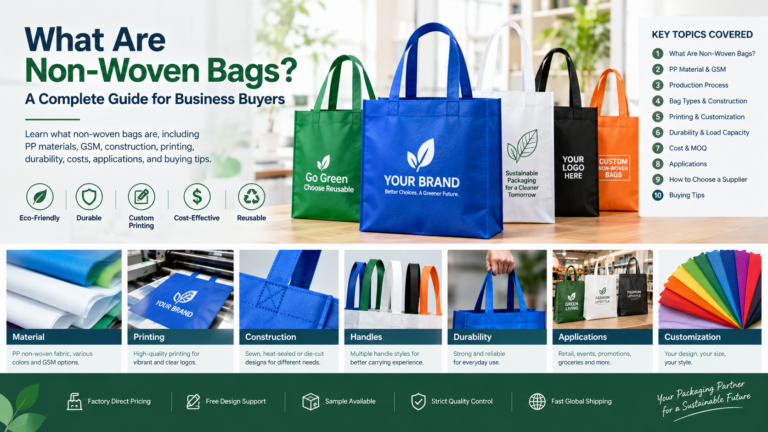

Non-woven bags have become a popular packaging and promotional solution for retailers, supermarkets, events, brands, and businesses looking for reusable alternatives to traditional plastic bags.
But what exactly is a non-woven bag?
For business buyers, the answer involves much more than simply knowing that the bag is “reusable.” Material type, fabric weight, lamination, printing, construction, handle design, carrying capacity, production method, and order quantity can all affect the final product.
If you are considering custom non-woven bags for your business, this guide explains what they are, how they are made, what options are available, and what buyers should consider before placing an order.
What Is a Non-Woven Bag?
A non-woven bag is a reusable bag made from non-woven fabric rather than traditional woven textiles.
Unlike woven fabric, which is produced by interlacing yarns, non-woven fabric is manufactured by bonding fibers together through mechanical, thermal, or chemical processes.
One of the most common materials used for commercial non-woven bags is polypropylene (PP).
PP non-woven fabric is lightweight, relatively durable, customizable, and suitable for a wide range of promotional and retail applications.
This combination makes non-woven bags particularly attractive for businesses that need branded bags in medium or large quantities.
What Are PP Non-Woven Bags?
PP stands for polypropylene, a thermoplastic polymer widely used in packaging and consumer products.
For non-woven bags, polypropylene fibers are processed into a sheet-like fabric that can then be cut, printed, folded, and assembled into bags.
PP non-woven bags are commonly used for:
- Retail shopping
- Supermarkets
- Promotional events
- Trade shows
- Conferences
- Brand campaigns
- Grocery shopping
- Corporate giveaways
- Product packaging
- Reusable shopping programs
For B2B buyers, PP non-woven bags offer a practical balance between cost, durability, customization, and production efficiency.
How Are Non-Woven Bags Made?
The manufacturing process depends on the bag construction, but a typical process includes several stages.
1. PP Raw Material
Polypropylene resin is processed into fibers.
The fibers are then formed into non-woven fabric through specialized manufacturing processes.
2. Fabric Formation
The fibers are arranged and bonded to create a continuous sheet of non-woven material.
The resulting fabric can be manufactured in different weights, colors, and specifications.
3. Fabric Cutting
Large rolls of non-woven fabric are cut according to the required bag dimensions.
4. Printing
The customer’s logo, graphics, text, or artwork is printed onto the fabric.
Depending on the project, different printing methods may be available.
5. Bag Forming
The fabric is folded and assembled into the required bag structure.
6. Handle Attachment
Handles can be integrated into the design or attached separately depending on the bag style.
7. Quality Inspection
Finished bags are inspected for printing, dimensions, construction, handles, appearance, and overall quality.
8. Packing and Shipping
The finished bags are counted, packed into cartons, and prepared for domestic or international delivery.
Understanding this process helps buyers evaluate whether a supplier has the manufacturing capabilities required for their project.
Non-Woven Bag GSM Explained
One of the most important specifications buyers will encounter is GSM.
GSM means grams per square meter and is commonly used to describe the weight of non-woven fabric.
For example, a 70 GSM fabric is lighter than a 120 GSM fabric.
Common commercial specifications may include approximately:
- 70 GSM
- 80 GSM
- 90 GSM
- 100 GSM
- 110 GSM
- 120 GSM
The appropriate GSM depends on the intended application.
Lightweight Bags
Lower-GSM fabric can be suitable for:
- Promotional events
- Giveaways
- Conferences
- Short-term campaigns
- Lightweight products
Medium-Weight Bags
Medium-weight fabric can provide a stronger balance between cost and durability.
It may be suitable for:
- Retail stores
- Supermarkets
- Promotional packaging
- Reusable shopping
Heavy-Duty Bags
Higher-GSM fabric is generally more suitable when buyers need additional structure and durability.
Potential applications include:
- Heavy retail products
- Grocery shopping
- Trade show materials
- Reusable promotional bags
- Long-term brand use
However, GSM should not be treated as the only indicator of bag strength.
Bag dimensions, handle construction, sewing or sealing methods, reinforcement, and material quality also affect carrying performance.
What Is Laminated Non-Woven Fabric?
Some non-woven bags use laminated fabric.
Lamination adds a thin film layer to the surface of the non-woven material.
This can provide advantages such as:
- Improved surface appearance
- Better print presentation
- Additional moisture resistance
- Easier surface cleaning
- Greater structural feel
Laminated non-woven bags can be particularly useful when the design requires high-quality graphics or a more polished appearance.
However, lamination also affects the material characteristics and cost, so it should be selected according to the intended application.
Non-Woven Bag Construction Types
Not all non-woven bags are manufactured in exactly the same way.
Different construction methods can provide different combinations of cost, appearance, production speed, and durability.
Sewn Non-Woven Bags
Sewn bags use stitching to connect fabric components.
They can provide strong construction and are suitable for reusable shopping and promotional applications.
They can also support more flexible bag designs and handle configurations.
Heat-Sealed Non-Woven Bags
Some non-woven bags are produced using heat-sealing or thermal bonding processes.
This can provide efficient production for certain bag structures and large-volume orders.
The appropriate construction depends on the bag’s design and performance requirements.
Die-Cut Non-Woven Bags
Die-cut bags can be manufactured by cutting the bag body and handles from a single piece of material.
They can be useful for simple promotional applications and high-volume campaigns.
Because there are fewer separate components, this type of bag can also have a different cost structure from sewn bags.
Handle Options for Non-Woven Bags
Handles are an important part of the bag’s usability and appearance.
Common options include:
- Self-material handles
- Cut-out handles
- Loop handles
- Reinforced handles
- Webbing handles
- Sewn handles
The best choice depends on:
- Bag size
- Product weight
- Intended usage
- Desired appearance
- Budget
- Production method
For heavier applications, buyers should pay particular attention to handle attachment and reinforcement.
A strong fabric body does not automatically mean the entire bag has high carrying capacity.
The weakest component can determine the practical performance of the finished bag.
How Strong Are Non-Woven Bags?
Non-woven bags can be durable enough for repeated use, but their performance depends on the complete construction.
Important factors include:
Fabric GSM
Higher GSM can provide a heavier and more substantial material.
Bag Size
Very large bags place more stress on the material and handles when loaded.
Handle Design
Handle width, material, attachment, and reinforcement all influence carrying performance.
Bottom Construction
A reinforced or properly constructed bottom can improve stability and load distribution.
Manufacturing Method
Sewn, heat-sealed, and die-cut bags have different structural characteristics.
Product Weight
The bag should be designed according to the weight and type of products it is expected to carry.
For this reason, buyers should communicate the intended load requirements to the manufacturer rather than simply requesting a particular GSM.
Custom Printing for Non-Woven Bags
One of the biggest advantages of non-woven bags for businesses is their large printable surface.
Brands can customize bags with:
- Logos
- Brand colors
- Slogans
- Product graphics
- Contact information
- Website addresses
- Promotional messages
- Event information
For B2B projects, artwork preparation is an important step.
Before production, buyers should confirm:
- Artwork dimensions
- Logo position
- Printing area
- Number of colors
- Color references
- Front and back artwork
- Required printing quality
For repeat orders, keeping the approved artwork and production sample as references can help maintain consistency between batches.
What Businesses Use Non-Woven Bags For
Non-woven bags are highly versatile.
Retail Stores
Fashion stores, department stores, gift shops, and specialty retailers can use branded bags to improve the shopping experience while providing customers with reusable packaging.
Supermarkets
Larger and stronger non-woven bags can be used for grocery shopping and repeated transportation of products.
Promotional Events
Non-woven bags are commonly used at:
- Trade shows
- Conferences
- Exhibitions
- Product launches
- Corporate events
They provide a convenient surface for displaying company branding.
Corporate Gifts
Businesses can customize reusable bags for employee gifts, customer packages, and marketing campaigns.
Promotional Campaigns
A branded reusable bag can continue displaying a company’s logo after the original event or purchase.
This gives the packaging a longer useful life than many single-use promotional materials.
Non-Woven Bags vs. Plastic Bags
One reason businesses consider non-woven bags is their reusable nature.
Traditional single-use plastic bags are primarily designed for short-term use.
A reusable non-woven bag can be designed for repeated shopping or promotional use.
For businesses, the comparison should consider more than material cost.
Factors include:
| Factor | Non-Woven Bags | Traditional Plastic Bags |
|---|---|---|
| Reusability | Generally designed for repeated use | Often designed for short-term use |
| Branding | Large printable surface | Depends on bag type |
| Structure | Can provide more structure | Often lightweight |
| Durability | Varies by GSM and construction | Varies by plastic type |
| Promotional value | High | Generally lower |
| Customization | High | High |
| Perceived value | Often higher | Often lower |
The right choice depends on the business application, local regulations, budget, and customer expectations.
Non-Woven Bags vs. Canvas Bags
Businesses may also compare non-woven bags with canvas or cotton bags.
Canvas generally provides a more textile-like, premium feel and can be suitable for brands looking for a natural fabric appearance.
Non-woven bags can offer advantages in terms of:
- Lower production cost
- Lightweight construction
- Large-scale production
- Flexible customization
- Promotional applications
Canvas bags may be more appropriate when the brand prioritizes premium textile quality and long-term reuse.
Neither material is universally better.
The right choice depends on the brand positioning and intended use.
How Much Do Custom Non-Woven Bags Cost?
There is no single price for a custom non-woven bag.
The final quotation can depend on:
- Material GSM
- Bag size
- Fabric color
- Printing
- Lamination
- Handle type
- Construction method
- Reinforcement
- Quantity
- Packaging
- Shipping destination
For example, a simple lightweight promotional bag may have a very different cost from a heavy-duty laminated retail bag with multiple-color printing and reinforced handles.
For accurate quotations, buyers should provide complete specifications whenever possible.
Why Order Quantity Matters
Quantity is another important factor in custom packaging pricing.
Large production runs can often achieve better unit economics because certain setup and production costs are distributed across more bags.
However, businesses should not automatically order the largest possible quantity.
Buyers should consider:
- Annual consumption
- Storage space
- Product lifecycle
- Seasonal demand
- Cash flow
- Shipping costs
- Expected repeat orders
The ideal order quantity is the one that balances unit cost with inventory risk.
What MOQ Should Buyers Expect?
MOQ means Minimum Order Quantity.
Different manufacturers may have different MOQs depending on:
- Bag construction
- Printing method
- Material
- Production process
- Customization requirements
For B2B buyers, MOQ should be evaluated together with the overall project cost.
A supplier with a lower MOQ may be more suitable for a new product launch or market test.
A supplier with a higher MOQ may offer better unit economics for established brands with predictable demand.
The key is to find a production quantity that fits the buyer’s actual business requirements.
What Should Buyers Ask Before Ordering?
Before placing an order for custom non-woven bags, buyers should confirm the following.
1. What material will be used?
Ask for the exact fabric type and GSM.
2. What construction method is recommended?
Discuss sewn, heat-sealed, or die-cut options based on the intended application.
3. What handle is appropriate?
The handle should match the expected product weight and bag design.
4. Is lamination necessary?
Lamination can improve appearance and surface properties, but it may not be necessary for every project.
5. Can I receive a sample?
A physical sample is useful for evaluating size, material, printing, construction, and carrying performance.
6. How is quality controlled?
Ask about material inspection, printing inspection, dimensional checks, handle testing, and final inspection.
7. What is the MOQ?
Confirm the minimum production quantity before finalizing the order.
8. What is the production lead time?
Production schedules can vary depending on quantity, customization, and factory workload.
9. How will the bags be packed?
Carton dimensions and packing methods can affect international shipping costs.
10. Can the factory handle repeat orders?
Consistency matters when the same packaging will be reordered regularly.
How to Choose a Non-Woven Bag Manufacturer
Choosing the right manufacturer can have a greater impact on the final result than choosing the lowest quotation.
B2B buyers should evaluate:
Manufacturing Experience
Look for suppliers with experience producing customized non-woven bags for commercial applications.
Production Capability
Ask whether the supplier can manufacture the required bag construction, size, printing, and quantity.
Quality Control
A reliable supplier should have clear inspection procedures.
Customization Options
Check available materials, GSM options, colors, printing, handles, lamination, and construction methods.
Sampling
The supplier should be able to provide samples or prototypes when required.
Production Capacity
For large orders, confirm that the factory has sufficient production capacity to meet the required schedule.
Communication
Clear communication can prevent mistakes in specifications, artwork, quantities, and delivery.
Export Experience
For international buyers, experience with overseas shipping and export packaging can simplify the purchasing process.
How to Write a Good Non-Woven Bag Specification
A clear specification makes supplier communication much easier.
Instead of simply sending:
“I need 20,000 custom non-woven bags.”
A better inquiry could include:
Product: Custom PP Non-Woven Bag
Size: 400 × 350 × 100 mm
Material: PP Non-Woven
GSM: 90 GSM
Color: Custom color
Printing: Front and back logo printing
Handle: Reinforced loop handles
Lamination: Optional
Quantity: 20,000 pcs
Application: Retail shopping
Destination: Required delivery location
Target Delivery: Required date
The more complete the specification, the easier it is for manufacturers to recommend an appropriate construction and provide an accurate quotation.
Are Non-Woven Bags Suitable for Your Business?
Non-woven bags can be a strong option if your business needs packaging that combines:
- Reusability
- Custom branding
- Flexible design
- Lightweight construction
- Commercial-scale production
- Competitive pricing
They are particularly suitable for retailers, supermarkets, promotional campaigns, events, and businesses that want their packaging to remain useful after the original purchase or event.
However, the right material and construction should always be selected according to the intended application.
A lightweight promotional bag and a heavy-duty retail bag should not necessarily use the same specifications.
Final Thoughts
Non-woven bags are more than simple reusable shopping bags.
For businesses, they are a customizable packaging and branding solution that can be adapted to different industries, applications, budgets, and production requirements.
The key specifications to understand include PP material, GSM, lamination, printing, construction, handles, dimensions, carrying capacity, MOQ, and quality control.
When purchasing custom non-woven bags, the most important step is to define your requirements clearly before production.
Start with the intended application.
Then determine the required size, material, GSM, construction, handle, printing, quantity, and performance requirements.
Finally, choose a manufacturer that can provide reliable production, consistent quality, clear communication, and dependable delivery.
With the right specifications and the right manufacturing partner, custom non-woven bags can become much more than packaging. They can become a practical, reusable extension of your brand.